
Roth 401k vs IRA is one of the most common retirement questions in America, and most answers stop at a single rule: pay tax now if you expect a higher tax rate later, pay tax later if you expect a lower one. That rule is correct, but it leaves out the part that decides the answer for most people who save seriously.
I ran the numbers both ways, including a comparison most guides skip, and found that when you put the same dollar amount into either account, the Roth usually wins even if your tax rate never changes. Below you’ll find the 2026 limits, a side-by-side of all four account types, how Australia and Korea handle the same question, and a calculator that shows what you’d actually keep after tax.
What’s in This Guide
401k vs Roth IRA: Take the Match First
Start with the order most financial planners agree on:
- Contribute to your workplace 401(k) up to the full employer match. A match is an instant 50% to 100% return you can’t get anywhere else.
- Then fund a Roth IRA, up to $7,500 in 2026 ($8,600 if you’re 50 or older), as long as your income is under the limit.
- Then go back to the 401(k) and raise contributions toward the $24,500 limit.
Pairing a workplace 401(k) with a Roth IRA is the most common setup: the 401(k) covers the match and the high limit, while the Roth IRA adds tax-free growth and flexibility. Whether your 401(k) money itself should go in as traditional (pre-tax) or Roth depends on your tax rate, and that’s where the calculator below helps.
Two details matter for 2026. Roth IRA eligibility phases out between $153,000 and $168,000 of income for single filers and $242,000 to $252,000 for married couples filing jointly, according to the IRS. And starting in 2026, workers who earned more than $150,000 in wages the year before must make any 401(k) catch-up contributions as Roth.
Roth 401k vs IRA: How the Four Accounts Compare
“401(k) vs IRA” and “Roth vs traditional” are two separate choices, which gives you four accounts. Most serious savers eventually run a Roth IRA 401k combination side by side rather than picking just one:
| Traditional 401(k) | Roth 401(k) | Traditional IRA | Roth IRA | |
|---|---|---|---|---|
| 2026 limit | $24,500 (+$8,000 at 50+) | Shares the 401(k) limit | $7,500 (+$1,100 at 50+) | Shares the IRA limit |
| Tax break | Deduct now, taxed later | Taxed now, tax-free later | Deduct now (income limits), taxed later | Taxed now, tax-free later |
| Income limit to contribute | None | None | None (deduction phases out) | $153,000–$168,000 single |
| Employer match | Yes | Yes | No | No |
| Required withdrawals at 73+ | Yes | No | Yes | No |
| Investment choices | Plan menu | Plan menu | Almost anything | Almost anything |
A few points the table can’t show:
- Roth IRA contributions (not earnings) can come out any time, tax- and penalty-free. That makes a Roth IRA a quiet backup emergency fund, though it works best if you never touch it.
- Workers aged 60 to 63 get a bigger 401(k) catch-up in 2026, $11,250 instead of $8,000.
- Tax diversification has value on its own. Having some pre-tax money and some Roth money lets you choose which bucket to draw from each year in retirement, which helps you manage your tax bracket.
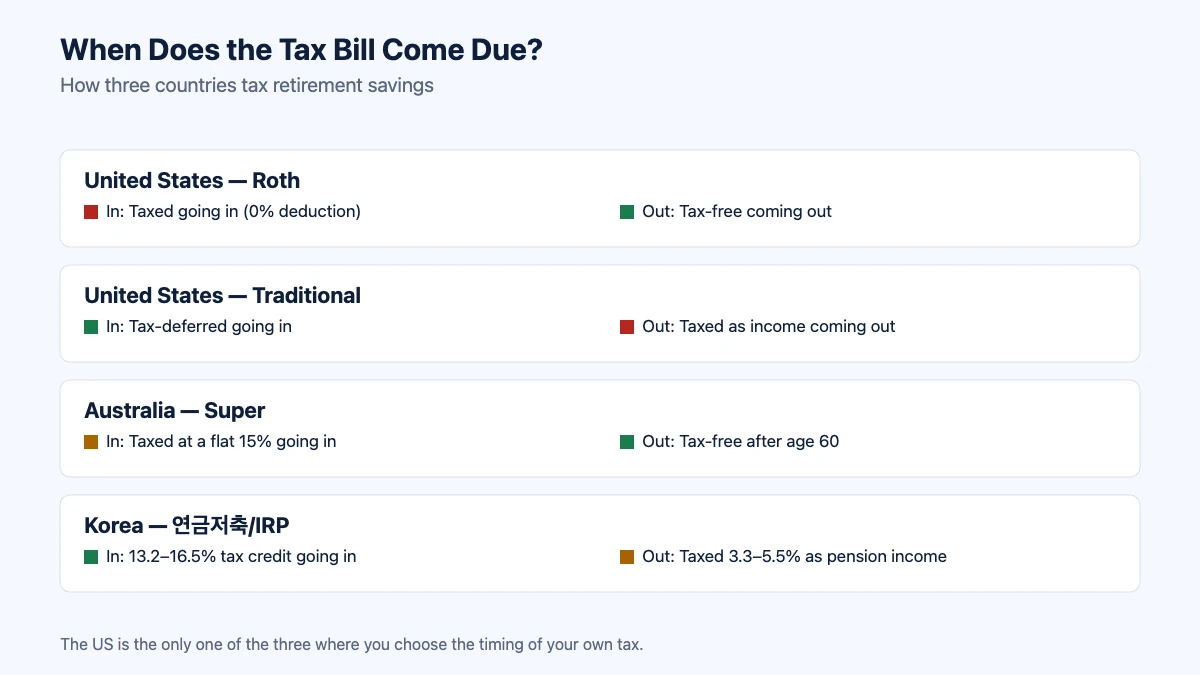
The same choice, timed differently. Comparing the three countries I know made the American choice clearer to me. In Australia, employer contributions to superannuation are taxed at a flat 15% going in, and withdrawals after 60 are generally tax-free, a hybrid that sits between Roth and traditional. Korea’s private pension accounts (연금저축 and IRP) work like a traditional account: contributions up to 9 million won a year earn a tax credit of 13.2% or 16.5%, and withdrawals taken as a pension are taxed at a low 3.3% to 5.5%. The US is unusual in letting individuals choose the timing of their tax each year, which is a real advantage if you use it deliberately.
Can You Contribute to a Roth IRA and a 401(k)?
Yes. A Roth IRA and a 401(k) have separate limits, so you can fund both in the same year. Having a 401(k) at work does not reduce what you can put in a Roth IRA; only your income does. (It can limit the tax deduction for a traditional IRA, which is a different rule.)
| Your age in 2026 | 401(k) limit | Roth IRA limit | Total you can save |
|---|---|---|---|
| Under 50 | $24,500 | $7,500 | $32,000 |
| 50 to 59, or 64 and older | $32,500 | $8,600 | $41,100 |
| 60 to 63 | $35,750 | $8,600 | $44,350 |
The Roth IRA column assumes your income is below the phase-out range: $153,000 for single filers and $242,000 for married couples filing jointly in 2026. Above $168,000 single or $252,000 joint, you can’t contribute directly, though many high earners use a “backdoor” Roth by contributing to a traditional IRA and converting it. One 2026 change to know: if you earned more than $150,000 in Social Security wages in 2025, any 401(k) catch-up contributions you make in 2026 must go into the Roth side of the plan.
A sensible order for most people: contribute enough to the 401(k) to get the full employer match, fill the Roth IRA, then go back to the 401(k). The calculator above shows whether Roth or traditional money makes more sense for each dollar.
Is a Roth IRA Taxable?
Not when you take money out the right way. You contribute money you’ve already paid tax on, so there’s no deduction going in. Your own contributions can come out at any time, tax- and penalty-free. Earnings come out tax-free once you’re 59½ and the account is at least five years old. Take earnings out before that, and they’re generally taxed plus a 10% penalty, with exceptions such as up to $10,000 for a first home.
What’s Better Than a Roth IRA?
Two things usually come first. An employer 401(k) match is an instant 50% or 100% return on the money it matches, which no IRA can beat. And if you have a high-deductible or bronze health plan, an HSA is deductible going in and tax-free coming out for medical costs, the only account with both breaks; our bronze plan HSA guide shows how it works. After those, a Roth IRA is one of the best accounts most people can open.
When Is a Roth the Better Bet? Run Your Numbers
The calculator compares the two ways people actually decide:
- Same take-home cost: you spend the same amount from your paycheck either way. A Roth contribution is smaller because it’s after tax. Here, the winner depends only on whether your tax rate is higher today or in retirement.
- Same contribution: you put the same dollars into either account, as people do when they max out. The traditional saver invests the yearly tax savings in a taxable account, where taxes shave off part of the return.
Compare what you would actually keep after taxes in retirement.
“Same contribution” puts the same dollar amount into either account; the traditional side also invests its yearly tax savings in a taxable account, where taxes are assumed to shave 15% off the return. “Same take-home cost” shrinks the Roth contribution by today’s tax rate so both cost you the same out of pocket. Contributions are made at year-end. Estimates only, not tax advice. Nothing you enter leaves your browser.
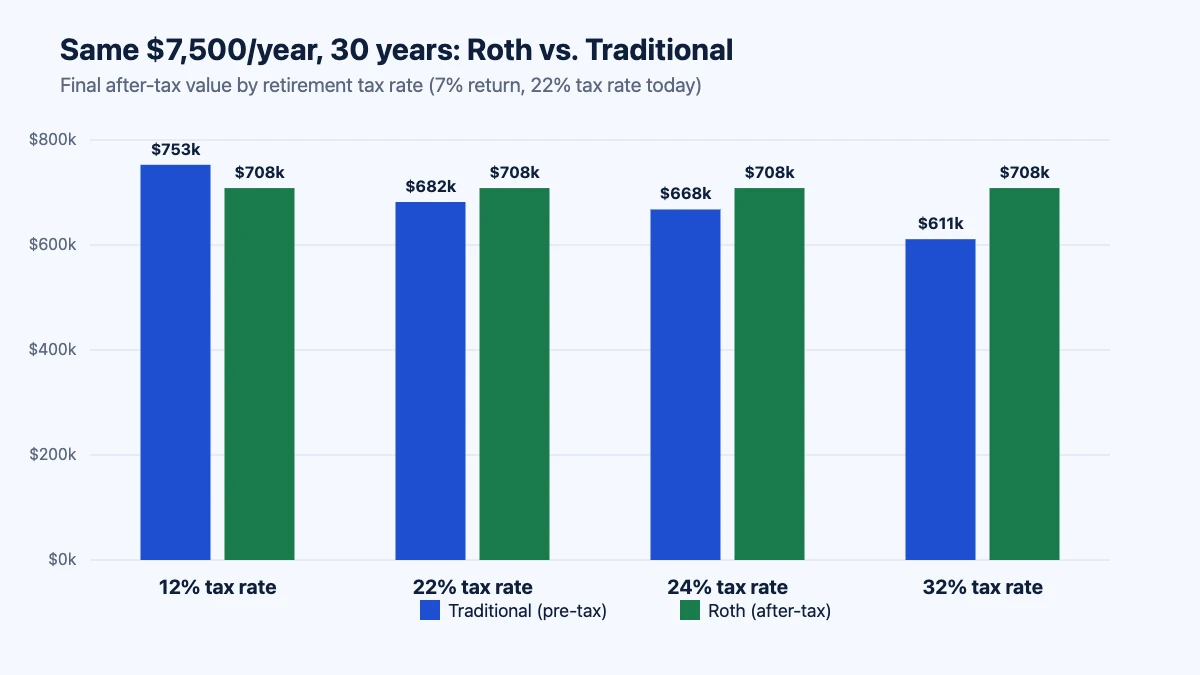
Here’s what I found for someone contributing $7,500 a year for 30 years at a 7% return, who pays 22% tax today:
| Tax rate in retirement | Traditional (same contribution) | Roth | Roth advantage |
|---|---|---|---|
| 12% | $752,745 | $708,456 | −$44,289 |
| 22% | $681,899 | $708,456 | +$26,557 |
| 24% | $667,730 | $708,456 | +$40,726 |
| 32% | $611,054 | $708,456 | +$97,402 |
The Roth wins in every case except a big drop in your tax rate, because $7,500 in a Roth is worth more than $7,500 in a traditional account: none of it belongs to the IRS. The traditional side only pulls ahead if your retirement tax rate falls well below today’s.
If you compare by same take-home cost instead, the result is a clean tie at equal tax rates ($552,596 either way), a $70,846 Roth win if your rate rises to 32%, and a $70,846 traditional win if it falls to 12%.
So when is a Roth the better bet? When you’re early in your career, when you expect your income or tax rates to rise, when you’re maxing out and want more money sheltered, or when you value tax-free flexibility later. Traditional makes more sense in your peak earning years, especially if you expect to retire in a lower bracket. If you’re not sure how much to put in overall, our retirement savings guide shows the savings rate you need for your age.
Frequently Asked Questions
What are the disadvantages of a Roth IRA?
You get no upfront tax break, so it does not lower your taxable income this year. Contribution limits are lower than a 401(k), and eligibility phases out above $153,000 (single) or $242,000 (married filing jointly) in 2026. Withdrawing earnings before age 59½ and before the account is 5 years old can trigger tax and a 10% penalty on the earnings portion.
How much will $2,000 in a Roth IRA grow to?
A single $2,000 contribution left to grow for 30 years at a 7% average annual return would be worth about $15,225, and it would come out completely tax-free. The result scales with your actual return and time horizon, so use the calculator above with your own numbers.
How much does $10,000 in a Roth IRA turn into?
At a 7% average annual return, $10,000 grows to about $76,123 after 30 years, or about $38,697 after 20 years. Because it is a Roth account, none of that growth is taxed when you withdraw it in retirement.
Does the 4% rule work with a Roth IRA?
Yes. The 4% rule estimates a starting withdrawal rate, not a tax rule, so it applies the same way to a Roth or a traditional account. The difference is what you keep: 4% of a traditional balance is reduced by income tax, while 4% of a Roth balance is yours in full.
Should I choose Roth or traditional if I don’t know my future tax rate?
Splitting new contributions between both is a reasonable hedge. It gives you tax-free money to draw on in high-income years and pre-tax money to draw on in low-income years, so you are not betting the whole outcome on a single guess about future tax rates.
Can I contribute to a Roth IRA and a 401(k) in the same year?
Yes. The limits are separate: in 2026 you can put up to $24,500 in a 401(k) and up to $7,500 in a Roth IRA, or $32,000 in total if you’re under 50. Your 401(k) doesn’t affect Roth IRA eligibility; only your income does, with the Roth IRA phasing out between $153,000 and $168,000 for single filers.
Is a Roth IRA taxable?
Qualified withdrawals are tax-free. You can take out your contributions at any time without tax or penalty, and earnings are tax-free after age 59½ once the account has been open five years. Earlier withdrawals of earnings are generally taxed and may face a 10% penalty.
What’s better than a Roth IRA?
An employer 401(k) match, because it’s free money, and an HSA if you have an eligible health plan, because it’s tax-free going in and coming out for medical costs. For most people, the order is: 401(k) up to the match, then a Roth IRA, then more 401(k).
There’s no wrong answer between a Roth and a 401(k) if you’re saving at all. Grab the match, lean Roth while your tax rate is low, and revisit the split whenever your income changes.
Read next
- 401(k) Balance by Age
- How Much Will My Social Security Increase in 2027?
- Bronze Plan + HSA vs. Silver Plan
- How Much to Save for College
Updated September 27, 2026. Written by Jun, who is not a licensed financial or tax advisor. Figures assume year-end contributions, a steady 7% return and, for the side account, taxes that reduce returns by 15%. Tax rules change, and your situation may differ. This article is for educational purposes only and is not financial or tax advice.
Sources: IRS, “401(k) limit increases to $24,500 for 2026, IRA limit increases to $7,500” · IRS Notice 2025-67 · Australian Taxation Office, super contributions and withdrawals · Korea National Tax Service, pension savings tax credit rules
Leave a Reply