
If you’ve ever typed “how much should I save for retirement” into a search bar, you’ve probably seen the same answer everywhere: 15% of your pay. That number is a good starting point, but it quietly assumes you began saving at 25. Most people didn’t. So the more useful question is how much you need to save from the age you are now.
I ran the numbers for every starting age from 25 to 50, compared the American system with the ones I know from Australia and Korea, and built a calculator that works out your own rate in today’s dollars. The short version: the right savings rate depends far more on when you begin than on how much you earn.
How Much to Save Depends on When You Start
Fidelity’s widely used retirement guideline says to save at least 15% of your pre-tax pay each year, including any employer match, from age 25 to 67. The goal is to reach about 10 times your final salary by 67, which, together with Social Security, should replace most of your working income.
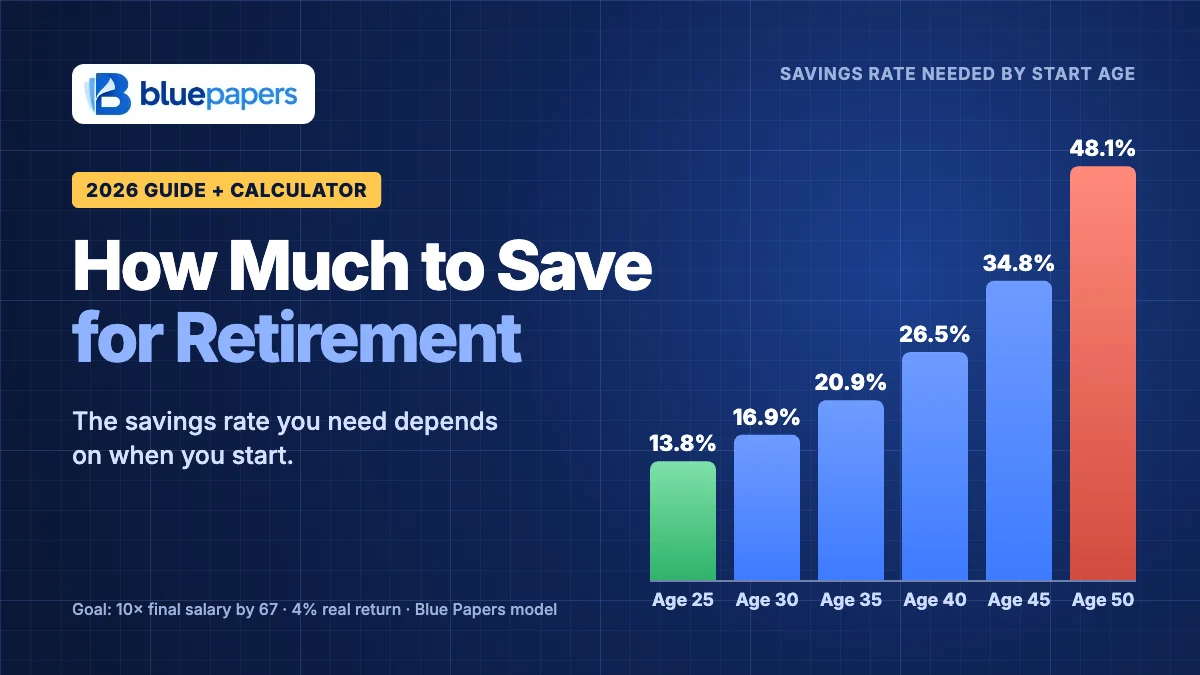
That 15% only works if you start at 25. To see what happens if you don’t, I modeled someone whose pay grows 1.5% a year above inflation and whose investments earn 4% a year after inflation, a deliberately cautious assumption. Here’s the savings rate needed to reach 10 times final salary by 67, starting from zero:
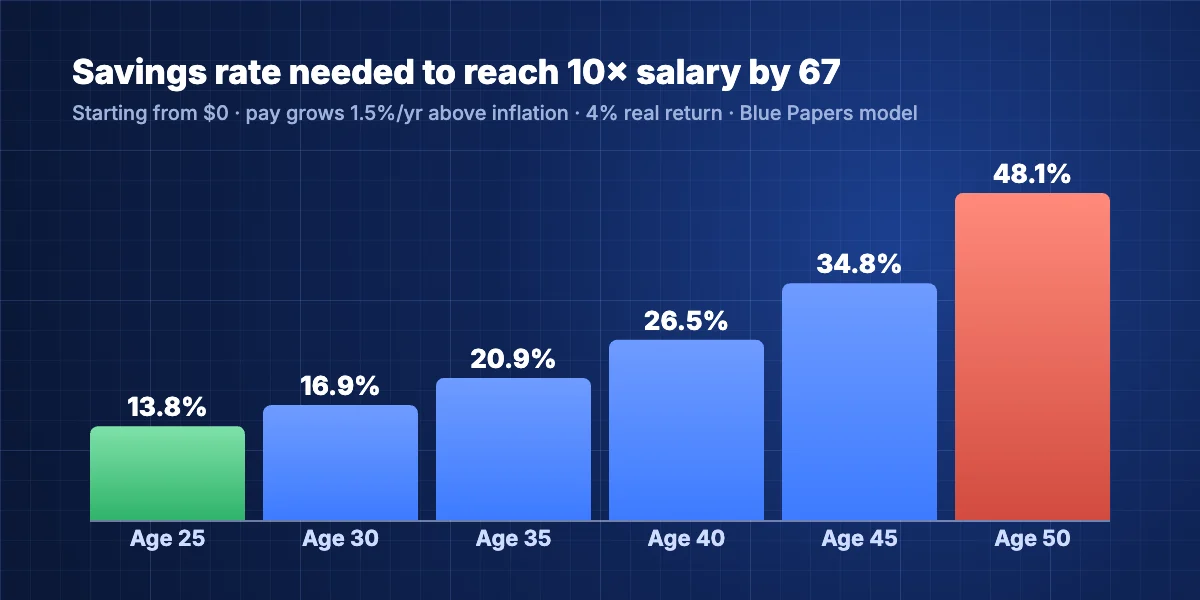
| Start saving at | Savings rate needed (4% real return) | At 5% real return |
|---|---|---|
| 25 | 13.8% | 10.9% |
| 30 | 16.9% | 13.8% |
| 35 | 20.9% | 17.6% |
| 40 | 26.5% | 23.0% |
| 45 | 34.8% | 31.1% |
| 50 | 48.1% | 44.2% |
My 25 and 30 results line up closely with Fidelity’s own figures (15% and 18%), which is a useful sanity check. The pattern is the important part: every five years of delay adds roughly three to thirteen percentage points to the rate you need, and the jumps get bigger the longer you wait.
The cost of waiting, in dollars. Put $500 a month ($6,000 a year) into a retirement account from age 25 to 67 at a 4% real return and you’d have about $629,000 in today’s dollars. Start the same $500 a month at 35 and you’d end with about $376,000. The later saver contributes $60,000 less but ends up roughly $253,000 behind. Those first ten years do the heaviest lifting because they have the longest time to compound. If you haven’t started yet, the best day to start saving for retirement is your next payday.
Already behind? Don’t panic. Most late starters rebuild their retirement savings with a mix of moves: raising their rate by 1% of pay every year, catching every dollar of employer match, using the extra catch-up contributions allowed from age 50, working a few more years, and delaying Social Security, which raises the monthly check by about 8% for each year you wait past full retirement age, up to 70.
Retirement Savings Calculator
Enter your details to see where you’re headed, the savings rate that gets you to 10 times your salary, and what a five-year pause would cost.
All results are in today’s dollars, so you can compare them with your current pay.
Assumes pay grows 1.5% a year above inflation and contributions are made once a year. Target follows Fidelity’s guideline of about 10 times your final salary by 67. Income uses the 4% rule. Social Security comes on top. Estimates only. Nothing you enter leaves your browser.
What the results mean. “Projected savings” is what your current habit would build by retirement, in today’s dollars. The 4% rule turns that into a rough yearly income: withdraw 4% in the first year, then adjust for inflation. Social Security comes on top. The average retired worker’s benefit in 2026 is about $2,071 a month, or roughly $24,900 a year, after this year’s 2.8% cost-of-living increase.
Why Americans need to save more on their own. When I lived in Australia, retirement saving was something that simply happened. Employers must pay 12% of your salary into a superannuation fund, on top of your wages. In Korea, the National Pension collects 9.5% of pay in 2026, split between worker and employer, with the rate set to rise gradually to 13%.
In the US, Social Security takes 6.2% from you and 6.2% from your employer, but it is designed to replace only part of your income, roughly 40% for an average earner. The rest is up to you, which is why the 15% target matters so much more here. An American who saves 12% of pay in a 401(k), including the match, is only doing what Australian law requires of every employer.
Where the money should come from. Before you raise your retirement savings, make sure your emergency fund is in place, so a surprise bill doesn’t turn into a 401(k) loan. If your budget feels too tight to find another 1% or 2%, our 50/30/20 guide shows how to keep savings at 20% even when needs run high. And to see how your retirement accounts compare with people your age, check our savings by age and net worth by age benchmarks.
Frequently Asked Questions
Can I retire at 60 with $500,000 in savings?
Possibly, if your spending is modest. The 4% rule suggests about $20,000 a year from $500,000. Social Security can’t start until 62, and the check is smaller the earlier you claim, so you would need to cover the gap years and health insurance before Medicare at 65. Many 60-year-olds with $500,000 work part time for a few years or delay Social Security to make the math work.
Is $400,000 enough to retire at 65?
For many people, yes, with Social Security. At 4%, $400,000 supports about $16,000 a year. Add the average 2026 retirement benefit of about $24,900 a year and you have roughly $40,900 before taxes. Whether that is enough depends on housing costs, health and where you live.
Can you retire on $1.5 million comfortably?
In most of the US, yes. The 4% rule gives about $60,000 a year in today’s dollars, and Social Security could add $25,000 to $50,000 more for a couple. That is above the median household income, so for most retirees it is a comfortable number.
What percentage of my paycheck should go to retirement?
Aim for 15% of gross pay, including your employer match, if you start in your mid-20s. Starting at 35, plan on roughly 18% to 21%, and at 40, closer to 23% to 27%, based on the table above.
Should I save for retirement or pay off debt first?
Do both in order. First, contribute enough to get the full employer match, because that is an instant return. Next, pay off high-rate debt such as credit cards. Then raise your retirement contributions toward 15%.
How much to save for retirement is “more than feels comfortable, and sooner than feels necessary.” Pick a rate you can automate today, raise it 1% every year, and let time do the rest.
Related guides
- 401(k) Balance by Age
- Roth 401k vs IRA
- How Much Will My Social Security Increase in 2027?
- Bronze Plan + HSA vs. Silver Plan
Updated September 26, 2026. Written by Jun, who is not a licensed financial advisor. Savings-rate figures are Blue Papers estimates that assume 1.5% annual real pay growth, year-end contributions and the stated real returns. Actual returns vary, and past performance does not guarantee future results. This article is for educational purposes only and is not financial advice.
Sources: Fidelity, “How much money should I save for retirement?” and retirement guidelines · Social Security Administration, 2026 cost-of-living adjustment · Australian Taxation Office, super guarantee rate · Korea National Pension Service, 2025 pension reform
Leave a Reply