
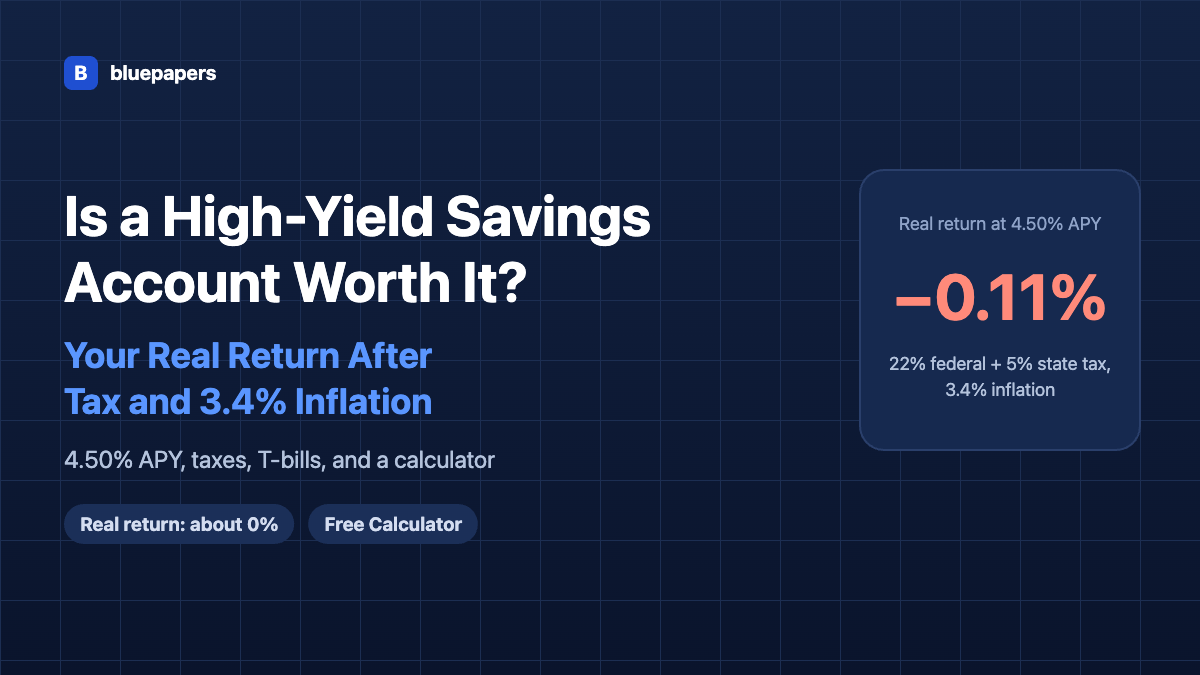
The best high-yield savings accounts pay up to about 4.50% APY right now, more than ten times the 0.37% national average. That number is real, but it isn’t what you keep. Savings interest is taxed as ordinary income, and inflation was running at 3.4% in August. Put those together and a 4.50% account earns many savers almost exactly nothing in real terms.
So is a high-yield savings account worth it? Yes, for the right money, and it beats a regular bank account by a wide margin. But it’s worth knowing what it really pays you, and when a Treasury bill or another account does better. Here’s the math after tax and inflation, plus a calculator that runs it for your bracket and your state.
Table of Contents
Is a High-Yield Account Worth It After Tax?
- Yes, compared with a regular savings account. On $20,000, a 0.37% account loses about $605 of buying power a year to inflation. A 4.50% account roughly breaks even.
- Yes, for your emergency fund and short-term goals. The job of that money is to be safe and available, not to grow. FDIC or NCUA insurance and same-week access matter more than a few tenths of a percent.
- Not as a long-term investment. After tax and inflation, the real return is close to zero or slightly negative for most middle-income savers. Money you won’t need for five years or more needs a higher expected return.
- Check Treasury bills if your state has an income tax. T-bill interest is exempt from state tax, which can make a lower T-bill yield pay more than a higher savings APY.
What a 4.50% Account Really Earns
Take $20,000 at 4.50% APY. That’s $900 of interest in a year. Here’s what’s left after tax and after inflation of 3.4%, for different tax situations:
| Tax situation | After-tax yield | Real return after 3.4% inflation | Buying power gained or lost on $20,000 |
|---|---|---|---|
| 12% federal, no state tax | 3.96% | +0.54% | +$108 |
| 22% federal, no state tax | 3.51% | +0.11% | +$21 |
| 22% federal, 5% state | 3.28% | −0.11% | −$22 |
| 24% federal, 9.3% state | 3.00% | −0.39% | −$77 |
| 32% federal, 9.3% state | 2.64% | −0.73% | −$147 |

For a typical middle-income saver, the best high-yield account is a near-perfect inflation hedge and nothing more. Higher earners in high-tax states lose a little buying power even at 4.50%. And most high-yield accounts don’t pay the top rate: at 4.00%, the 22% bracket in a 5% state comes out at −0.46% real. Compare that with a big-bank account at the 0.37% FDIC national average: after tax, it loses about 3% of its value every year at today’s inflation.
Why Savings Rates Went Back Up This Fall
On September 16, 2026, the Federal Reserve raised its target range by a quarter point to 3.75% to 4.00%, its first increase since 2023, after inflation climbed back to 3.4% in August, according to the Bureau of Labor Statistics. Online banks tend to follow the Fed quickly, which is why top savings rates sit at 4.25% to 4.50%. But the same inflation that pushed rates up eats the interest. A higher APY in an inflationary year doesn’t mean a better real return; it often means the same real return at a higher headline number.
One practical point: high-yield APYs are variable. If the Fed stops raising, or starts cutting, online banks can lower your rate at any time without notice. Check your rate every few months and move if a better account appears.
High-Yield Savings Real Return Calculator
Enter your balance, your account’s APY, your federal tax bracket and your state’s income tax rate. The calculator shows what you keep, your real return after inflation, and the APY your savings account needs to match Treasury bills after tax.
Savings interest is taxed as ordinary income by the IRS and your state. Treasury bill interest is federally taxable but exempt from state and local income tax. Real return = (1 + after-tax return) ÷ (1 + inflation) − 1. The comparison with a big-bank account uses the FDIC national average savings rate of 0.37%. One year, no compounding beyond the APY, and no deduction for state taxes on your federal return. Estimates only, not financial advice. Nothing you enter leaves your browser.
When Treasury Bills Beat a High-Yield Savings Account
Treasury bills paid about 4.1% on the 13-week bill in early October, a little less than the best savings accounts. But T-bill interest is exempt from state and local income tax. If you live in a state with an income tax, the break-even savings APY is higher than it looks:
| Tax situation | 4.11% T-bill after tax | Savings APY needed to match |
|---|---|---|
| 22% federal, no state tax | 3.21% | 4.11% |
| 22% federal, 5% state | 3.21% | 4.39% |
| 24% federal, 9.3% state | 3.12% | 4.68% |
| 32% federal, 9.3% state | 2.79% | 4.76% |
In a high-tax state like California, a savings account would need to pay around 4.7% to match a 4.1% T-bill. You can buy T-bills directly at TreasuryDirect or through most brokerage accounts, and money market funds that hold mostly Treasuries can pass along some or all of the state tax exemption, depending on your state’s rules. The trade-offs are small: T-bills lock your money for weeks or months unless you sell them in a brokerage account, and they take a little more setup than a savings account.
Where Each Dollar Belongs
| Money | Best home | Why |
|---|---|---|
| Bills for the next month | Checking | Instant access matters more than interest |
| Emergency fund (3–6 months) | High-yield savings | Insured, available in a day or two, and roughly keeps pace with inflation |
| Goals 1–3 years out | High-yield savings, CDs or T-bills | Lock a rate if you know the date; T-bills if your state tax is high |
| Money for 5+ years | Retirement accounts and diversified investments | A savings account’s real return is near zero |
If you’re not sure how big the emergency fund should be, our emergency fund calculator works it out from your expenses, and our average savings by age guide shows how your cash compares with others your age.
Bonus Rates in Australia, a Flat 15.4% in Korea
In Australia, interest is taxed at your marginal rate too, but banks make you work for the top rate. The best-paying accounts are “bonus saver” accounts: the headline rate only applies in months when you deposit a set amount and make no withdrawals. Miss one condition and you drop to a base rate that’s often a fraction of the bonus. American high-yield accounts are simpler; the rate you see is generally the rate you get.
Korea takes a flat cut instead. Interest is taxed at a flat 15.4% (14% national plus 1.4% local), withheld by the bank before you see it, no matter your income bracket. On top of that, savers can use an ISA (개인종합자산관리계좌), where the first ₩2 million of net income is tax-free and the rest is taxed at 9.9%. For a U.S. saver in the 22% or 24% bracket plus state tax, the Korean flat rate would actually be lower, which shows how much of an American savings account’s yield goes to tax.
How to Pick a High-Yield Savings Account
- Confirm the insurance. Look for FDIC (banks) or NCUA (credit unions) coverage, up to $250,000 per depositor, per institution, per ownership category. With fintech apps, check which partner bank holds the money.
- Ignore teaser rates. Some accounts pay the top APY only for a few months or only up to a capped balance.
- Check the fine print. No monthly fees and no minimum balance should be the standard.
- Test transfer speed. For an emergency fund, one or two business days to your checking account is what you need.
- Plan for the 1099-INT. If you earn $10 or more in interest, the bank reports it to the IRS. Set aside tax on it so April isn’t a surprise.
Frequently Asked Questions
Is a high-yield savings account worth it in 2026?
Yes for your emergency fund and short-term savings. Top accounts pay up to about 4.50% APY, compared with a 0.37% national average, which is the difference between losing about 3% of your money’s buying power each year and roughly breaking even after tax and 3.4% inflation. It isn’t a long-term investment, because the real return is close to zero.
How is high-yield savings account interest taxed?
Interest from a high-yield savings account is taxed as ordinary income at your federal rate and, in most states, your state rate. If you earn $10 or more, the bank sends you and the IRS a Form 1099-INT. In the 22% bracket with a 5% state tax, a 4.50% APY becomes about 3.28% after tax.
Is a high-yield savings account safe?
Yes, if it’s at an FDIC-insured bank or an NCUA-insured credit union. Deposits are insured up to $250,000 per depositor, per institution, per ownership category. If you use a fintech app, confirm which partner bank holds your money and that pass-through insurance applies.
Is a high-yield savings account better than Treasury bills?
It depends on your state tax. T-bill interest is exempt from state and local income tax. With a 4.11% T-bill, a savings account needs about 4.39% to match in a state with a 5% income tax, and about 4.7% in a high-tax state like California. In states with no income tax, the higher APY wins.
How much should I keep in a high-yield savings account?
Enough for an emergency fund of three to six months of essential expenses, plus money for goals within the next few years, such as a car or a down payment. Money you won’t need for five years or more usually belongs in retirement accounts or diversified investments.
Is a high-yield savings account worth it? For your emergency fund, absolutely: it’s the difference between losing about 3% a year and roughly breaking even. Just don’t mistake a 4.50% APY for growth. After tax and 3.4% inflation, it’s protection, and that’s exactly what cash is for.
Read next
- Net Worth by Age
- How Much to Save for Christmas
- How Much to Save for College
- How Much Should I Save for Retirement?
Updated October 9, 2026. Written by Jun, who is not a licensed financial advisor. Examples use a 4.50% APY, 3.4% inflation (CPI, August 2026), a 4.11% 13-week Treasury bill yield (early October 2026) and the 0.37% FDIC national savings average. Rates change often; check current rates before you move money. Calculator results are estimates for planning only.
Sources: Bureau of Labor Statistics, Consumer Price Index (August 2026) · Federal Reserve, FOMC statement (September 16, 2026) · FDIC, national rates and rate caps · U.S. Treasury, daily Treasury bill rates · Fortune and Curinos, savings rate survey (September 30, 2026) · Korea National Tax Service, interest income tax · Ministry of Economy and Finance (Korea), ISA rules
Leave a Reply