
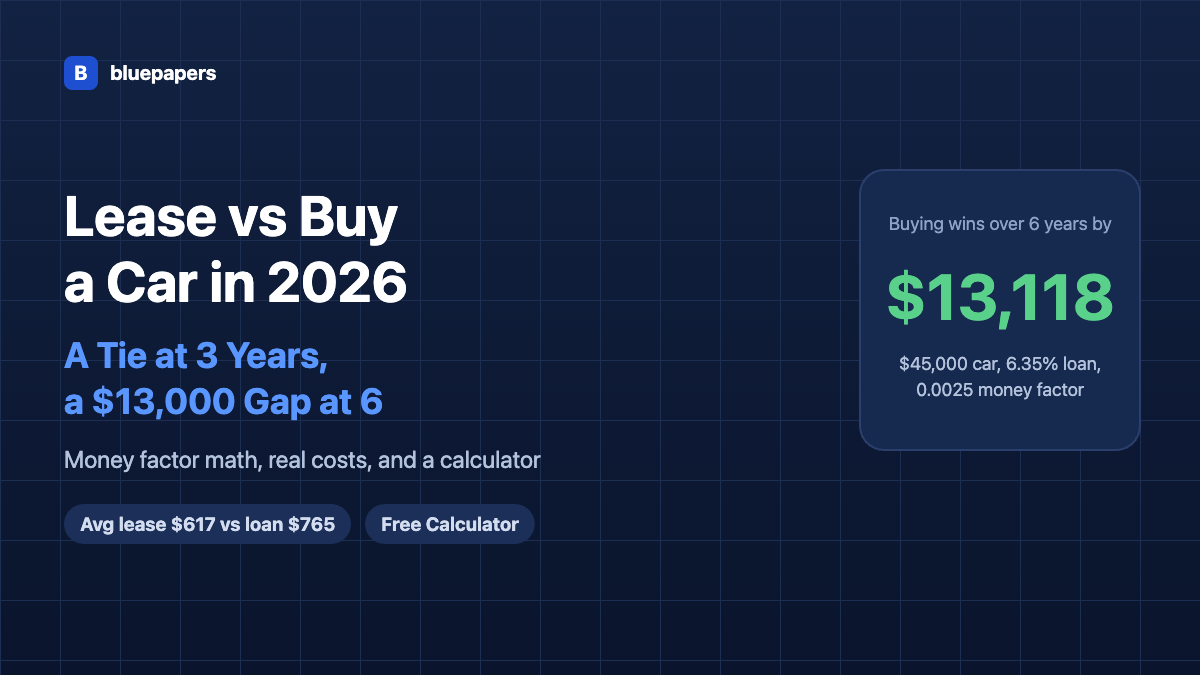
The average new-car lease payment was $617 a month in the second quarter of 2026, according to Experian. The average new-car loan payment was $765. That $148 gap is why about one in four new cars is leased, and it’s also why the lease vs buy question gets answered wrong so often. A lower payment doesn’t mean a lower cost.
Here’s what the numbers actually show. Over a typical three-year lease, leasing and buying cost almost the same. The difference shows up in what happens next. A buyer who keeps the car for six years comes out more than $13,000 ahead of someone who leases twice. This guide walks through both, explains the one number dealers hope you won’t ask about, and gives you a calculator for any car.
Table of Contents
Lease vs Buy: The Gap Shows Up After Year Three
- Buy if you’ll keep the car five years or longer, drive more than about 12,000 miles a year, or want no restrictions on how you use it.
- Lease if you want a new car every two or three years anyway, drive predictable low miles, and can get a subsidized lease with a low money factor and a high residual.
- Over one lease term, it’s close to a tie. On a $45,000 car, three years of leasing costs about $25,400 and three years of owning costs about $24,800, if the car keeps its expected value.
- Over six years, buying wins clearly. Leasing twice costs about $50,800; buying and keeping the car costs about $37,700, even after $3,600 of extra repairs.
How a Lease Payment Is Calculated
A lease payment has two parts. The depreciation charge pays for the value the car loses while you drive it: the price you negotiated, minus your down payment, minus the residual value (what the leasing company expects the car to be worth at the end), divided by the number of months. The finance charge is the lease’s version of interest: the price minus your down payment, plus the residual, times the money factor.
Take a $45,000 car with $3,000 down, a 58% residual and a money factor of 0.0025 for 36 months. The residual is $26,100. The depreciation charge is ($42,000 − $26,100) ÷ 36 = $442 a month. The finance charge is ($42,000 + $26,100) × 0.0025 = $170 a month. Together that’s a $612 payment before tax, close to the national average.
The Number to Ask For: Money Factor × 2,400
Dealers quote the money factor as a small decimal because 0.0025 doesn’t sound like much. Multiply it by 2,400 and you get the equivalent interest rate: 0.0025 is 6%. A money factor of 0.00125 is 3%, and 0.0035 is 8.4%. Always ask for the money factor in writing and convert it. If it’s higher than the rate you could get on a car loan, or higher than the “buy rate” the manufacturer’s finance company publishes, it’s been marked up and it’s negotiable.
| Money factor | Equivalent APR | Payment on the example car |
|---|---|---|
| 0.00125 | 3.0% | $527 |
| 0.0025 | 6.0% | $612 |
| 0.0035 | 8.4% | $680 |
Lease vs Buy Over Three Years: Nearly a Tie
Now buy the same $45,000 car with the same $3,000 down and a 60-month loan at 6.35%, the average new-car rate in Experian’s latest data. The payment is $819 a month. After 36 payments, you’ve paid $32,478 in total, but you still own a car worth about $26,100 and owe $18,410 on it. That’s $7,690 of equity, so your real three-year cost is about $24,787.
| Over 36 months | Lease | Buy (60-month loan) |
|---|---|---|
| Monthly payment | $612 | $819 |
| Total paid (incl. $3,000 down) | $25,424 (incl. $395 disposition fee) | $32,478 |
| Equity at the end | $0 | $7,690 |
| Real cost | $25,424 | $24,787 |
The buyer’s advantage depends entirely on what the car is worth at the end. If it’s worth 62% of the price instead of 58%, buying is about $2,400 cheaper. If it’s worth only 50%, buying costs about $3,000 more than leasing. That’s the one real advantage of a lease: the leasing company carries the risk that the car is worth less than expected. With a longer 72-month loan, the payment drops to $703, but you’d have only $3,111 of equity after three years.
Over Six Years, Buying Wins by $13,000

The lease vs buy math changes completely after the loan is paid off. A leaser who signs a second identical lease pays about $50,848 over six years and owns nothing. A buyer who keeps the car pays off the loan in year five, drives payment-free in year six, and still owns a car worth about $18,000 (40% of the original price). Even after adding $1,200 a year of extra repairs in years four to six, owning costs about $37,730, roughly $13,100 less.
This is the real lesson: leasing isn’t a bad deal; it’s the cost of always driving a car in its most expensive years. A new car loses value fastest early on, and a leaser pays for those years again and again. If you’d trade in after three years either way, leasing and buying are close. If you’d keep the car, buy it. Our how much car can I afford guide shows what payment fits your income.
Lease vs Buy Car Calculator
Use the negotiated price, not the sticker price, and the residual and money factor from the dealer’s lease quote. The calculator shows the lease payment and its equivalent APR, the cost of each option over the lease term, and the six-year comparison.
The car
Lease
Buy with a loan
Lease payment = (price − cash down − residual) ÷ term, plus (price − cash down + residual) × money factor. Money factor × 2,400 = the equivalent interest rate. Buying cost over a period = cash down + loan payments made − (car’s value − loan balance left). The buyer’s car is assumed to be worth the residual value at the end of the lease term. The 6-year comparison assumes a second lease on identical terms and a 6-year value you set. Sales tax, registration, insurance, mileage overage and wear charges are not included. Estimates only. Nothing you enter leaves your browser.
When Leasing Actually Wins
Some lease vs buy decisions do go the other way. Manufacturers sometimes subsidize leases to move a model, with a low money factor, a high residual or both. In the calculator, try a 3% money factor (0.00125) with a 62% residual on the same car: the lease drops to $479 a month and costs about $2,350 less than buying over three years. Leasing can also make sense for:
- Electric vehicles, where battery technology and resale values change quickly and the lessor carries the risk.
- Business use, where lease payments may be partly deductible. Talk to a tax professional before you count on it.
- Drivers who value a warranty-covered car and a fixed budget over the lowest long-run cost.
Watch for the costs that don’t show up in the payment: mileage limits (commonly 10,000 to 12,000 miles a year, with overage fees often 15 to 25 cents a mile), wear-and-tear charges, the disposition fee at the end, and the penalty for ending a lease early, which can run into thousands of dollars.
Novated Leases and Korea’s Long-Term Rentals
In Australia, the most popular way to lease isn’t through a dealer at all. It’s a novated lease: your employer pays the lease out of your pre-tax salary, so the car comes out of income before tax is taken. Since July 2022, electric cars under the luxury car tax threshold have been exempt from fringe benefits tax in these arrangements, which can make a leased EV far cheaper than one bought with after-tax dollars. Plug-in hybrids lost that exemption in April 2025. There’s no general American equivalent, so a U.S. lease has to win on its own numbers.
In Korea, long-term rental (장기렌트) competes directly with leasing. A rental bundles insurance, registration taxes and maintenance into one monthly fee, which appeals to young drivers facing high insurance premiums and to businesses that want a single expense. The cars carry distinctive rental license plates, so everyone can tell. The lesson travels: the best deal depends on what’s bundled into the payment, so compare total costs, not monthly ones.
Before You Sign Either One
- Negotiate the price first. A lease is calculated from the price, just like a loan. A lower price lowers both payments.
- Get the money factor, residual and fees in writing, and convert the money factor to an APR.
- Get a loan preapproval from a bank or credit union so your lease vs buy comparison uses a real rate and you can compare the dealer’s financing. Your credit score is the biggest factor in the rate; see how to build credit if yours needs work.
- Put down as little as possible on a lease. If the car is totaled early, gap coverage pays off the lease, but a large down payment is usually lost.
- Run the lease vs buy numbers in the calculator for the number of years you’ll really keep the car.
Frequently Asked Questions
Is it better to lease or buy a car in 2026?
It depends on how long you’ll keep the car. Over a single three-year lease term, leasing and buying cost about the same on a typical $45,000 car. If you keep a car you buy for six years, you’ll usually come out more than $10,000 ahead of someone who leases twice. Leasing makes the most sense if you’ll switch cars every few years anyway and can get a subsidized lease.
What is a good money factor on a lease?
Multiply the money factor by 2,400 to get the equivalent interest rate. A money factor of 0.0025 equals 6%, close to the 6.35% average new-car loan rate in mid-2026. A good money factor is at or below what you’d pay on a car loan with your credit, and the manufacturer’s published buy rate. Anything higher has likely been marked up.
Why are lease payments lower than loan payments?
A lease payment only covers the car’s expected loss in value during the lease, plus a finance charge, while a loan payment pays off the car’s full price. In the second quarter of 2026, the average new-car lease payment was $617 a month, compared with $765 for a new-car loan, according to Experian. At the end of a lease, though, you own nothing.
Can you buy your car at the end of a lease?
Usually, yes. Your lease lists a purchase option price, which is generally the residual value plus any purchase fee. Buying makes sense if the car is worth more than that price on the open market or if you know it’s been well maintained. If it’s worth less, return it and let the leasing company absorb the loss.
Does leasing a car affect your credit?
Yes, in the same way as a car loan. A lease is reported to the credit bureaus, on-time payments help your score, and the monthly payment counts toward your debt-to-income ratio when you apply for a mortgage or other loans.
Lease vs buy isn’t really a question about payments. It’s a question about how long you’ll keep the car. Over one three-year term, the two cost about the same. Every year you keep a car you own after it’s paid off is where buying pulls ahead, and on a typical new car that’s worth more than $13,000 over six years.
Updated October 10, 2026. Written by Jun, who is not a licensed financial advisor. Examples assume a $45,000 negotiated price, $3,000 down, a 58% residual after 36 months, a 0.0025 money factor, a $395 disposition fee, a 60-month loan at 6.35% and a car worth 40% of its price after six years. Sales tax, insurance and fees vary by state. Calculator results are estimates for planning only.
Sources: Experian, State of the Automotive Finance Market (Q2 2026) · Consumer Financial Protection Bureau, auto leasing basics · Australian Taxation Office, electric car fringe benefits tax exemption
Leave a Reply