
$579 a month. That’s roughly what it takes, starting the week your child is born, to cover the full sticker price of four years at an in-state public university — about $220,000 by the time they enroll in 2044, if costs keep rising 3% a year. For a private college, it’s more than $1,200 a month.
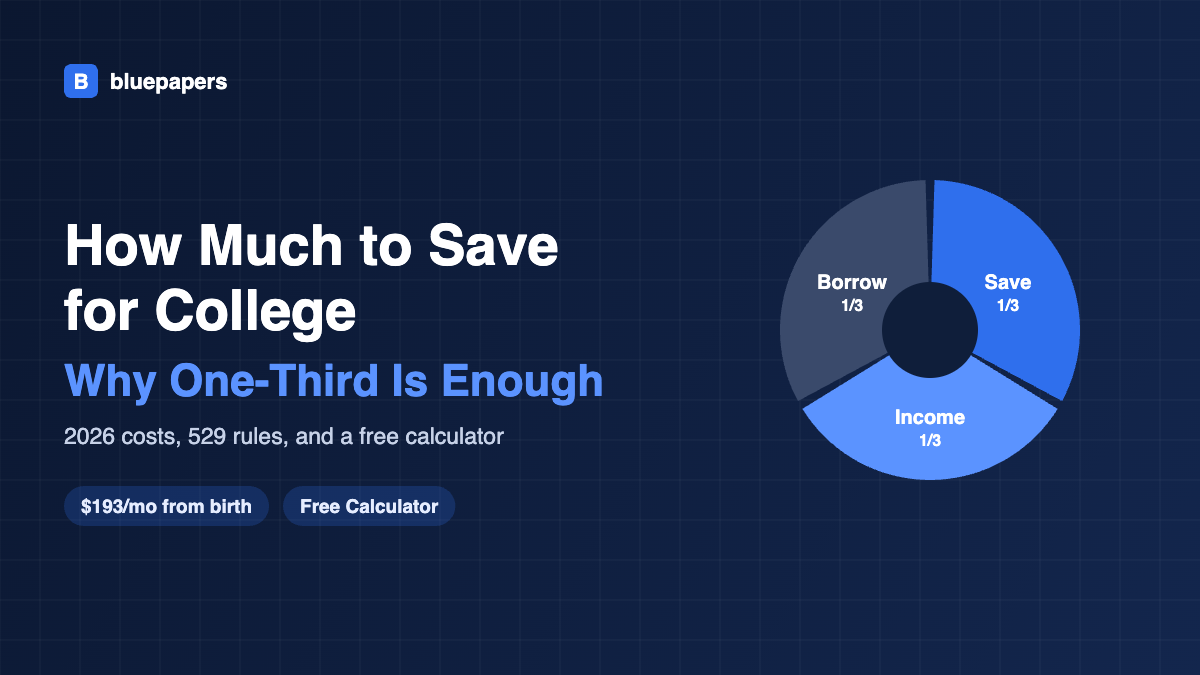
Most families read a number like that and either give up or panic. Both reactions come from the same mistake: assuming you have to save the whole thing. You don’t, and almost nobody does. The real question behind how much to save for college is what share of the bill your savings need to cover — and for most families, the honest answer is about one-third.
Table of Contents
How Much to Save for College: Aim for One-Third
A widely used rule of thumb from college-finance expert Mark Kantrowitz splits the cost of college three ways: save one-third before your child starts, pay one-third from income during the college years, and borrow no more than one-third. Here’s what the “save one-third” part costs per month, depending on how old your child is when you start:
| Child’s age when you start | Public in-state (1/3 goal) | Private nonprofit (1/3 goal) |
|---|---|---|
| Newborn | $193/month | $408/month |
| 5 | $273/month | $576/month |
| 10 | $449/month | $948/month |
| 14 | $902/month | $1,906/month |
These figures start from the College Board’s 2025-26 average published budgets — $30,990 a year for tuition, fees, housing and food at an in-state public four-year school, and $65,470 at a private nonprofit — grow that cost 3% a year, and assume your savings earn 6% a year until the first tuition bill. Notice what happens down the table: the goal actually shrinks for older kids, because costs have less time to grow — yet the monthly amount more than quadruples between a newborn and a 14-year-old. Time does most of the saving for you, if you give it the chance.

Sticker Price vs. What Families Actually Pay
The published price of college is a bit like the rack rate on a hotel door. According to the College Board’s Trends in College Pricing 2025, average published tuition and fees at a public four-year school are $11,950 for in-state students this year. After grant aid, the average first-year, full-time student actually pays an estimated $2,300 in net tuition and fees. At private nonprofit colleges, the sticker price is $45,000; the average net tuition is about $16,910.
Housing and food don’t get discounted nearly as much, which is why the total budget is still the right starting point for planning. But it explains why saving 100% of the sticker price is usually overshooting — and why the calculator below lets you choose what share you want to cover rather than assuming all of it.
I’ll admit to a personal reason for caring about this distinction. My daughter studies in the US as an international student, and international students generally can’t receive federal grants or federal student loans, so I’ve spent more time looking at sticker prices than most parents ever need to.
For most American families, though, the number on the college website is not the bill. Every college is required to post a net price calculator on its website — run it for the schools your child is actually considering before you decide how much to save for college.
Why One-Third Is Enough: The Three-Way Split
The one-third rule works because college isn’t paid for in one lump sum on your child’s 18th birthday. It’s paid over four years, and three different sources can carry part of it:
- Past savings (one-third). This is the part that benefits from 10 to 18 years of compounding, which is why every dollar here is the cheapest dollar you’ll spend on college.
- Current income (one-third). Four years of paying part of the bill from your paycheck and your student’s part-time work — the same way you once paid for daycare. If you’re currently spending on childcare, that line in your budget frees up years before college begins — redirect it into the college fund when it does.
- Borrowing (no more than one-third). Federal Direct Loans let a dependent undergraduate borrow up to $5,500 in the first year, rising to $7,500 by the third and fourth years — $27,000 over four years. The Federal Student Aid loan limits are a useful ceiling: if your plan needs much more borrowing than that, the school is probably too expensive for the plan.
There’s also a fourth source hiding in plain sight: grants and scholarships, which shrink the total before any of the three thirds kick in. That’s why one-third of the sticker budget is a conservative target, not a bare minimum.
One more thing the rule quietly assumes: that your own retirement comes first. Your child can borrow for college; nobody lends you money to retire. If you’re not yet on track with how much to save for retirement, fix that before you raise the college number.
College Savings Calculator: How Much to Save Each Month
To see how much to save for college in your own situation, pick the type of school, your child’s age, and what share of the cost you want your savings to cover. If you already have a 529 balance, enter it — it keeps compounding until the first tuition bill.
Default costs are College Board 2025-26 average published budgets (tuition, fees, housing and food) for a full-time student. Each future year’s cost grows at the rate you set; college is assumed to start at 18 and last four years. Savings grow at your expected return, compounded monthly, until the first day of college. Estimates only, not financial advice. Nothing you enter leaves your browser.
Where the Money Should Live: 529 Plans in 2026
For most families the answer is a 529 plan: contributions grow tax-free, and withdrawals are tax-free when spent on qualified education costs. Many states also give you a state income tax deduction for contributing to your own state’s plan. A few details matter more than which plan you pick:
- It barely dents financial aid. A parent-owned 529 is counted as a parental asset on the FAFSA, and parental assets are assessed at no more than 5.64% — so a $30,000 balance reduces aid eligibility by at most about $1,700.
- The rules got wider in 2026. Under the 2025 tax law, the annual limit for K-12 tuition withdrawals doubled from $10,000 to $20,000 starting January 1, 2026, and 529 money can now pay for recognized postsecondary credential programs such as welding, plumbing, or commercial driving — not just four-year degrees. Savingforcollege.com’s summary of the new 529 rules covers the details, including which states haven’t conformed yet.
- “What if they don’t go?” has a better answer now. Up to $35,000 of leftover 529 money can be rolled into the beneficiary’s Roth IRA over their lifetime, subject to the annual Roth contribution limit, as long as the account has been open at least 15 years. It’s one more reason to open the account early, even with a small amount. (Our Roth 401k vs IRA guide explains why a Roth head start matters so much.)
Pay Later in Australia, Lower Tuition in Korea
American parents are asked to pre-fund college in a way parents in the other two countries I know well are not. In Australia, where I lived for over a decade, most domestic university students defer their fees through HECS-HELP, a government loan that isn’t repaid until they earn above a set income threshold — about A$67,000 for 2025-26 — and is then collected automatically through the tax system.
There’s no widely used Australian equivalent of the 529, because there’s no expectation that parents will have saved a six-figure sum by the student’s 18th birthday. The bill follows the graduate, and it scales with what they earn.
Korea sits somewhere in between. University tuition is far lower than at a US private college, income-based national scholarships (국가장학금) cover a large share of it for lower- and middle-income families, and there’s an income-contingent government student loan that is repaid after the graduate finds work. The heavy spending in Korea tends to happen earlier — on private academies before university — rather than on the degree itself.
Seen from either country, the one-third rule looks less like a compromise and more like common sense: the student, the parents’ current income, and the parents’ past savings each carry a share.
Frequently Asked Questions
How much should I have saved for college by age 10?
On the one-third plan for an in-state public university, a family that started at birth would have about $31,000 saved by age 10 — roughly $13,400 at age 5 and $50,000 at 14 — assuming a 6% return. For a private nonprofit college, the same plan puts you at about $66,000 by age 10. If you’re behind those numbers, the calculator shows what it takes to catch up from where you are.
Is it too late to start saving for college at 14 or 15?
No. With four years left, most of the goal comes from your own contributions rather than investment growth, so the monthly number is higher — about $902 a month to cover one-third of an in-state public school starting at 14. But every dollar saved is a dollar your child doesn’t borrow, and a 529 still gives you tax-free growth and, in many states, a state tax deduction.
What happens to a 529 if my child doesn’t go to college?
You have several options: change the beneficiary to a sibling or another family member, use the money for trade school or a recognized credential program, keep it for graduate school, or roll up to $35,000 over the beneficiary’s lifetime into their Roth IRA if the account has been open at least 15 years. Non-qualified withdrawals are possible, but the earnings are taxed and usually hit with a 10% penalty.
Should I save for college or retirement first?
Retirement first, in most cases. Students can borrow for college, but there is no loan for retirement, and money in your own retirement accounts generally isn’t counted against you on the FAFSA. Once you’re capturing any employer match and saving enough for retirement, add college savings on top — even a small monthly 529 contribution started early goes a long way.
Deciding how much to save for college isn’t about funding the whole degree — you don’t need to do that to do right by your kid. A steady one-third, started early and left alone, does more than an anxious plan to cover everything that never quite gets started. If money is tight, open the 529 with whatever you can — even $25 a month — keep your emergency fund intact, and raise the contribution every time your income rises.
Read next
Updated October 1, 2026. Written by Jun, who is not a licensed financial advisor. Cost figures use College Board 2025-26 averages; projections assume 3% annual cost growth and a 6% annual return and are estimates, not guarantees. Check your state’s 529 plan for its own tax rules.
Sources: College Board, Trends in College Pricing and Student Aid 2025 · Federal Student Aid (studentaid.gov), Direct Loan annual limits · Savingforcollege.com, 529 plan rule changes for 2026 · Australian Taxation Office, study and training loan repayment thresholds 2025-26 · Korea Student Aid Foundation, 국가장학금 and 취업 후 상환 학자금대출
Leave a Reply