
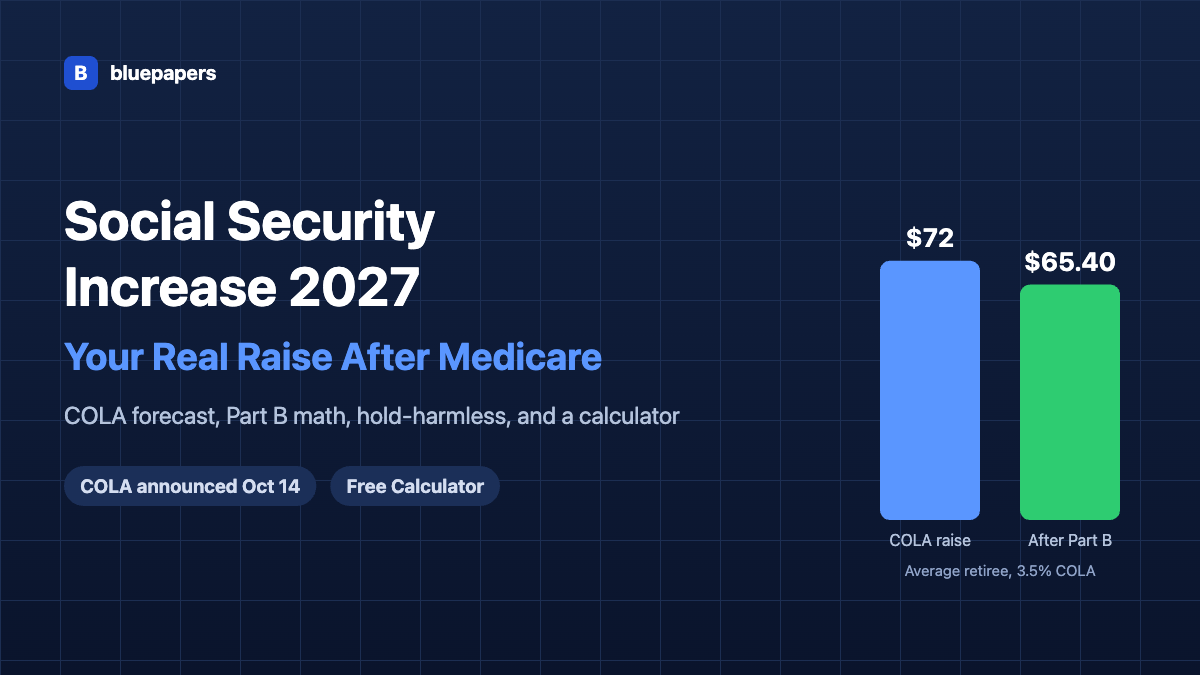
On October 14, the Social Security Administration will announce the 2027 cost-of-living adjustment, and every headline will lead with one percentage. The forecasts cluster around 3.5% to 3.6%. On the average retired worker’s check, that’s roughly $72 a month. But that isn’t the number that shows up in your bank account in January.
For most retirees, the Medicare Part B premium comes out of the Social Security check before it’s deposited. When Part B goes up, part of the raise disappears before you ever see it. In 2026, that took about a third of the COLA for a typical retiree. This guide shows your likely Social Security increase in 2027 after Medicare, who is protected from the premium hike, who isn’t, and a calculator that does the math for your own check.
Table of Contents
Your 2027 Raise, After Medicare
With two of the three months of inflation data in, The Senior Citizens League estimates a 2027 COLA of 3.5%, while AARP and Kiplinger’s economist put it at 3.6%. The final figure depends on September’s inflation report, released the same morning as the announcement. Meanwhile, the 2026 Medicare Trustees Report projects the standard Part B premium will rise from $202.90 to $209.50 a month, and private forecasters expect it could reach $216 to $219.
Here’s what a 3.5% COLA means for your Social Security increase in 2027 once Part B is taken out, at different benefit levels:
| Monthly benefit now | COLA raise (3.5%) | Real raise if Part B is $209.50 | Real raise if Part B is $219 |
|---|---|---|---|
| $1,200 | $42 | $35.40 | $25.90 |
| $1,600 | $56 | $49.40 | $39.90 |
| $2,075 (average retiree) | $72 | $65.40 | $55.90 |
| $2,500 | $87 | $80.40 | $70.90 |
| $3,500 | $122 | $115.40 | $105.90 |
The average is based on the Social Security Administration’s monthly statistical snapshot, which put the average retired-worker benefit at $2,074.53 at the start of 2026. Raises are rounded down to the whole dollar, the way Social Security rounds the amount it pays. The table assumes you pay the standard Part B premium and it’s deducted from your check.
Update note: this page uses forecasts until October 14, 2026. We’ll replace them with the official COLA once the Social Security Administration publishes it, and with the official Part B premium when Medicare announces it, usually in November.
How the 2027 COLA Is Calculated
The formula is set by law, so there’s no negotiation and no political decision involved. As the Social Security Administration explains, it compares the average Consumer Price Index for Urban Wage Earners and Clerical Workers (CPI-W) for July, August and September of 2026 with the same three months of 2025. The percentage increase, rounded to one decimal place, becomes the COLA. If prices didn’t rise, there’s no COLA, and benefits never go down.
That’s why the date is October 14 this year: the Bureau of Labor Statistics releases September’s inflation numbers that morning at 8:30 a.m. Eastern, and the Social Security Administration publishes the COLA right after. The same announcement includes the 2027 taxable maximum for payroll taxes and the earnings limits for people who claim benefits before full retirement age.
One detail matters for retirees: CPI-W tracks the spending of working households, not older ones. The Bureau of Labor Statistics also publishes an experimental index for Americans 62 and older (CPI-E), which gives more weight to housing and medical care. It isn’t used for the COLA.
How Much of the Raise Medicare Takes
The COLA is a percentage. The Part B increase is a flat dollar amount that’s the same for everyone who pays the standard premium. So the smaller your check, the bigger the share of your Social Security increase in 2027 that Medicare takes. Here’s how that played out on a $2,000 monthly check over the past five years:
| Year | COLA | Raise on $2,000 | Standard Part B premium | Change in Part B | Real raise |
|---|---|---|---|---|---|
| 2023 | 8.7% | $174 | $164.90 | −$5.20 | $179.20 |
| 2024 | 3.2% | $64 | $174.70 | +$9.80 | $54.20 |
| 2025 | 2.5% | $50 | $185.00 | +$10.30 | $39.70 |
| 2026 | 2.8% | $56 | $202.90 | +$17.90 | $38.10 |
| 2027 (est.) | 3.5% | $70 | $209.50 to $219.00 | +$6.60 to +$16.10 | $53.90 to $63.40 |

Look at 2026: a 2.8% COLA was a bit higher than 2025’s 2.5%, but the real raise was smaller, because Part B jumped $17.90. Medicare took 32% of the raise. For 2027, the Trustees’ projection would take only about 9% of a $2,000 check’s raise. If private forecasters are right and the premium lands near $219, that share rises to 23%.
The Hold-Harmless Rule: Who’s Protected
Federal law keeps most retirees from losing money on the swap. Under the hold-harmless provision, if the Part B increase would be larger than your Social Security increase in 2027, your premium increase is cut down to the size of your raise, so your deposit doesn’t shrink. With a 3.5% COLA and a $6.60 premium increase, that only matters for checks below about $189 a month. If the premium hits $219, the line moves to about $460.
To be protected, you generally need to have received Social Security in November and December 2026 with Part B deducted from those checks. Three groups are not protected:
- New enrollees. If you start Medicare or Social Security in 2027, you pay the full 2027 premium.
- Higher-income retirees. Anyone paying an income-related premium (IRMAA) pays the full increase.
- People who pay Part B directly. If your premium isn’t deducted from Social Security, the rule doesn’t apply. People whose state Medicaid program pays their premium aren’t affected either way.
If You Pay IRMAA, the Hit Is Bigger
In 2026, single filers with income above $109,000 (or $218,000 for joint filers) on their 2024 tax return pay an income-related Part B premium of $284.10 to $689.90 a month. Those premiums are set as multiples of the standard premium, from 1.4 to 3.4 times, so they rise faster when the standard premium rises. At the top bracket, a $6.60 increase in the standard premium becomes about $22 a month. Your 2027 bracket will be based on your 2025 tax return. If your income has dropped since then because you stopped working or had another life-changing event, you can ask Social Security to use a more recent year with Form SSA-44.
Social Security Increase Calculator for 2027
Enter your current monthly benefit before Medicare is taken out. You’ll find it on your 2026 COLA notice or in your my Social Security account. The calculator shows your Social Security increase in 2027 before and after the Part B change, and checks whether the hold-harmless rule protects you. You can change the COLA to the official figure once it’s announced.
The COLA is applied to the benefit you enter and rounded down to the whole dollar, as Social Security does with the amount it pays. Part B figures use the 2026 standard premium of $202.90 and the income-related (IRMAA) premiums as fixed multiples of the standard premium. IRMAA brackets for 2027 are based on 2025 tax returns and will be adjusted for inflation. The hold-harmless check assumes Part B was deducted from your Social Security check in November and December 2026. Part D surcharges, Medicare Advantage premiums and tax withholding are not included. Estimates only, not financial advice. Nothing you enter leaves your browser.
When the New Amount Shows Up
Your Social Security increase in 2027 arrives in stages, and the first official numbers come in October:
- October 14, 2026: the official COLA is announced.
- November 2026: Medicare usually announces the 2027 Part B premium and deductible.
- Early December 2026: your personal COLA notice, showing your new gross benefit and deductions, appears in your my Social Security account’s Message Center. Paper notices follow by mail.
- December 31, 2026: SSI recipients get the higher January 2027 payment a day early, because January 1 is a holiday.
- January 2027: Social Security payments with the COLA arrive on your usual payment date (the 3rd, or the second, third or fourth Wednesday, depending on your birth date and when you started benefits).
Social Security Disability Insurance (SSDI) gets the same COLA as retirement benefits, and the same Part B math applies once you’re on Medicare. SSI goes up by the same percentage, but SSI recipients’ Part B premiums are generally paid by their state.
What to Do Before January
- Use Medicare open enrollment. It runs from October 15 to December 7. Part D and Medicare Advantage premiums change every year and can change by more than your whole COLA. Comparing plans on Medicare.gov’s plan finder is the one move that can change your real raise this fall.
- Check your tax withholding. If you have federal tax withheld from Social Security, a bigger check may push up the tax you owe. Form W-4V sets the withholding rate.
- Re-run your budget with the net number. Plan with your net Social Security increase in 2027 and the deposit you’ll actually receive, not the headline percentage. If you’re still building savings, our emergency fund calculator helps you decide how much of the raise to set aside.
- If you’re still working, the COLA also raises benefits you haven’t claimed yet. COLAs apply to your benefit base starting at age 62, even before you file. Our retirement savings guide covers the rest of the picture.
Twice a Year in Australia, Once in Korea
Australia adjusts its Age Pension twice a year, on March 20 and September 20. The difference is how the raise lands: instead of one adjustment set by a few months of prices, the pension catches up every six months. It rises by whichever is higher, the regular CPI or a separate cost-of-living index built for pensioner and beneficiary households. On top of that, the combined rate for couples is benchmarked to at least 41.76% of average male full-time weekly earnings, so the pension also keeps pace with wages, not just prices.
Korea’s National Pension (국민연금) goes up once a year, in January, by the previous year’s consumer price inflation. For 2026, that was 2.1%, applied to both the National Pension and the Basic Pension (기초연금) for low-income seniors. Like the U.S., Korea uses a single annual price adjustment, but it uses the full year’s inflation rather than just three months, and there’s no premium deduction that eats into it.
The American system stands out in two ways: the raise is locked in by just three months of a price index built for working households, and a separate program’s premium is taken out of the same check. Neither is likely to change soon, which is why knowing your net number matters more than the headline.
Frequently Asked Questions
How much will my Social Security increase in 2027?
Your Social Security increase in 2027 equals your current benefit times the COLA, which forecasters put at 3.5% to 3.6% before the official announcement on October 14, 2026. For the average retired worker, that’s about $72 a month. If Medicare Part B is deducted from your check, subtract the premium increase: about $6.60 a month if the Medicare Trustees’ projection of $209.50 holds, or up to $16.10 if the premium reaches $219.
When will the 2027 COLA be announced?
The Social Security Administration will announce it on October 14, 2026, right after the Bureau of Labor Statistics releases September’s Consumer Price Index at 8:30 a.m. Eastern. The COLA is based on the average CPI-W for July, August and September.
Will the Medicare Part B premium go up in 2027?
Almost certainly. The 2026 Medicare Trustees Report projects the standard premium will rise from $202.90 to $209.50 a month, and some private forecasters expect $216 to $219. Medicare usually announces the official 2027 premium in November.
Do SSDI recipients get the 2027 COLA?
Yes. Social Security Disability Insurance benefits rise by the same COLA as retirement benefits, and SSI payments rise by the same percentage. If you’re on Medicare and Part B is deducted from your SSDI check, the same premium math applies.
When will I see the 2027 increase in my check?
Your Social Security increase in 2027 shows up in the payment you receive in January 2027, on your regular payment date. SSI recipients get the higher payment on December 31, 2026, because January 1 is a holiday. Your personal COLA notice appears in your my Social Security account in early December.
The 2027 COLA will be a good one by recent standards, and for most retirees the Part B increase looks smaller than last year’s. But the number to plan around is your net Social Security increase in 2027, the gap between this January’s deposit and the next. Run your own figures in the calculator, then check again on October 14 when the official COLA is out.
Read next
- 401(k) Balance by Age
- Roth 401k vs IRA
- Bronze Plan + HSA vs. Silver Plan
- Is a High-Yield Savings Account Worth It?
Updated October 6, 2026. Written by Jun, who is not a licensed financial advisor. COLA figures are forecasts until the Social Security Administration’s announcement on October 14, 2026; the 2027 Part B premium is a projection until Medicare announces it. Calculator results are estimates for planning only.
Sources: Social Security Administration, Cost-of-Living Adjustment information and Monthly Statistical Snapshot · 2026 Medicare Trustees Report · Centers for Medicare and Medicaid Services, Part B premium announcements (2023–2026) · The Senior Citizens League and AARP 2027 COLA estimates (September 2026) · Bureau of Labor Statistics, Consumer Price Index · Services Australia, Age Pension indexation · Ministry of Health and Welfare (Korea), 2026 pension adjustment
Leave a Reply