
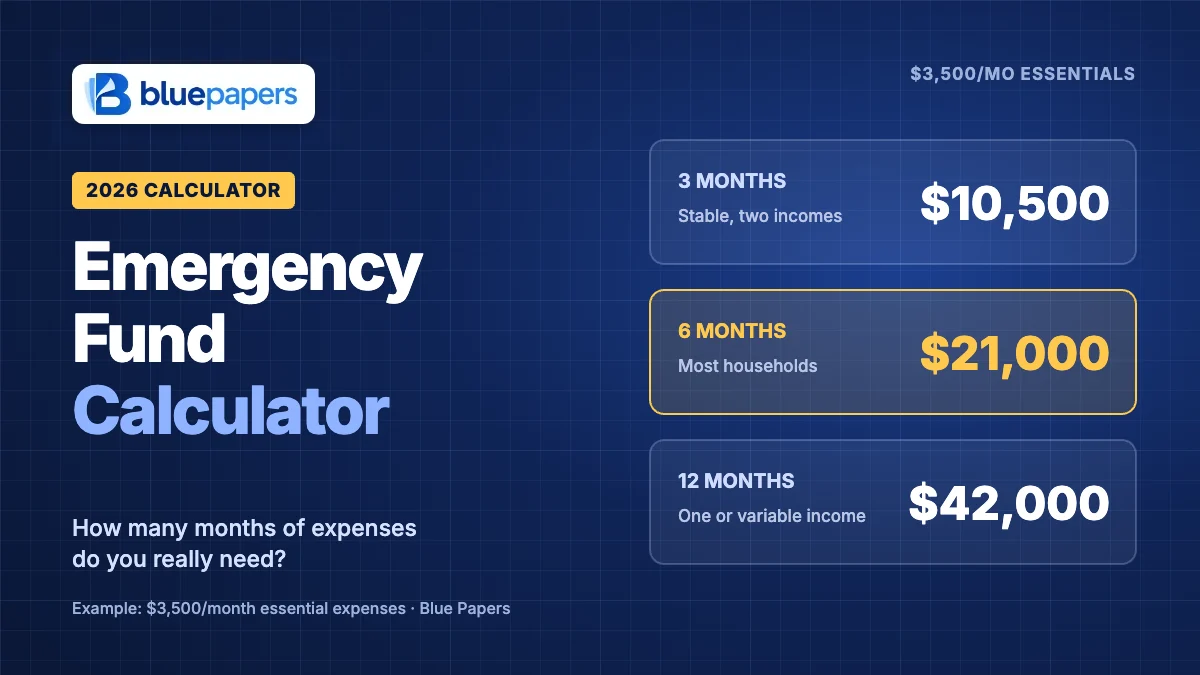
How big should an emergency fund be? Most people need 3 to 6 months of essential expenses in an emergency fund. If your household runs on one income, a commission paycheck or self-employment, aim for 6 to 12 months. For a household that spends $3,500 a month on essentials, that means about $10,500 to $21,000, and up to $42,000 for the most cautious target.
The right number depends on how stable your income is, who depends on you and how quickly you could replace your job. This free emergency fund calculator weighs all three and gives you a target in dollars, plus how long it will take to get there.
Table of Contents
Free Emergency Fund Calculator
Emergency fund targets are personal, so start with your own numbers. Enter what you spend each month on essentials, choose your income situation and tick any risk factors that apply. The emergency fund calculator suggests how many months to save, turns that into a dollar target and shows how far along you are.
Answer five questions. Your target updates as you type.
Rule of thumb only: 3 months for two stable incomes, 6 for one, 9 for variable income, plus extra months for dependents, home or car repair risk and a slow job market in your field. Capped at 12 months. Nothing you enter leaves your browser.
How to read your result: the big number is your full target. The three boxes below it show the classic 3-, 6- and 12-month benchmarks for comparison. If you’re far from your target, don’t panic. The step-by-step plan later in this guide shows how to close the gap, starting with a small first milestone.
How Many Months of Expenses Do You Really Need?
The classic advice is 3 to 6 months of expenses. That range still holds for most people, but where you land inside it, or whether you need more, depends on how exposed your income is. Here’s the logic the emergency fund calculator uses:
| Your situation | Suggested months | Why |
|---|---|---|
| Two stable incomes | 3 months | If one earner loses a job, the other paycheck still covers part of the bills. |
| One stable income | 6 months | A job loss stops all income, and job searches often take months. |
| Variable, commission or self-employed | 9 months | Income can drop without warning, and slow seasons are common. |
| Children or others depend on you | +1 month | Fewer expenses can be cut in a crisis. |
| You own a home or an older car | +1 month | Big repairs are more likely and harder to postpone. |
| Your job would be hard to replace | +3 months | Senior, specialized or local-only roles can take longer to fill. |
Why is 6 months the safest default for most single-income households? Look at how long job searches actually last. The emergency fund calculator builds this data into its suggestions.
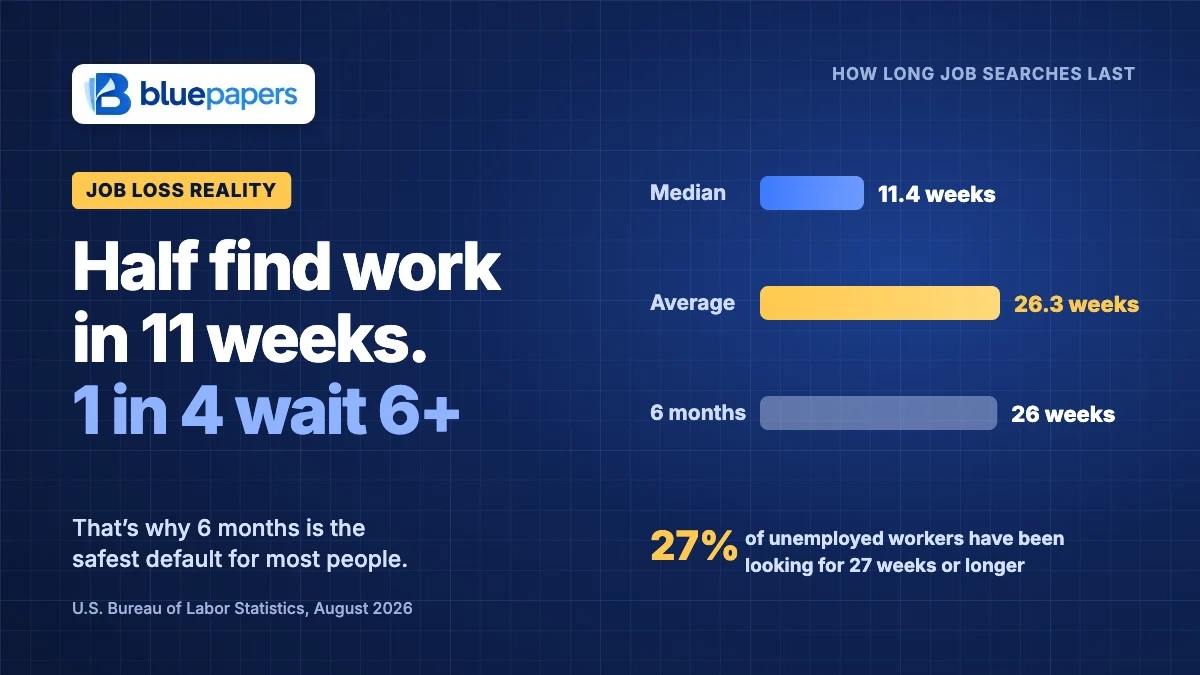
According to the U.S. Bureau of Labor Statistics, the median unemployed worker in August 2026 had been looking for about 11.4 weeks, but the average was 26.3 weeks, roughly six months. And 27% of unemployed workers had been out of work for 27 weeks or longer. A 3-month fund covers a typical job search. A 6-month fund covers most of the bad ones.
Job loss isn’t the only emergency, of course. Medical bills, a broken transmission, an emergency flight home or a sudden rent increase can all hit at once. Your emergency fund is what keeps those events from landing on a credit card at 24% interest.
Example: 6 Months Emergency Fund Expense Breakdown
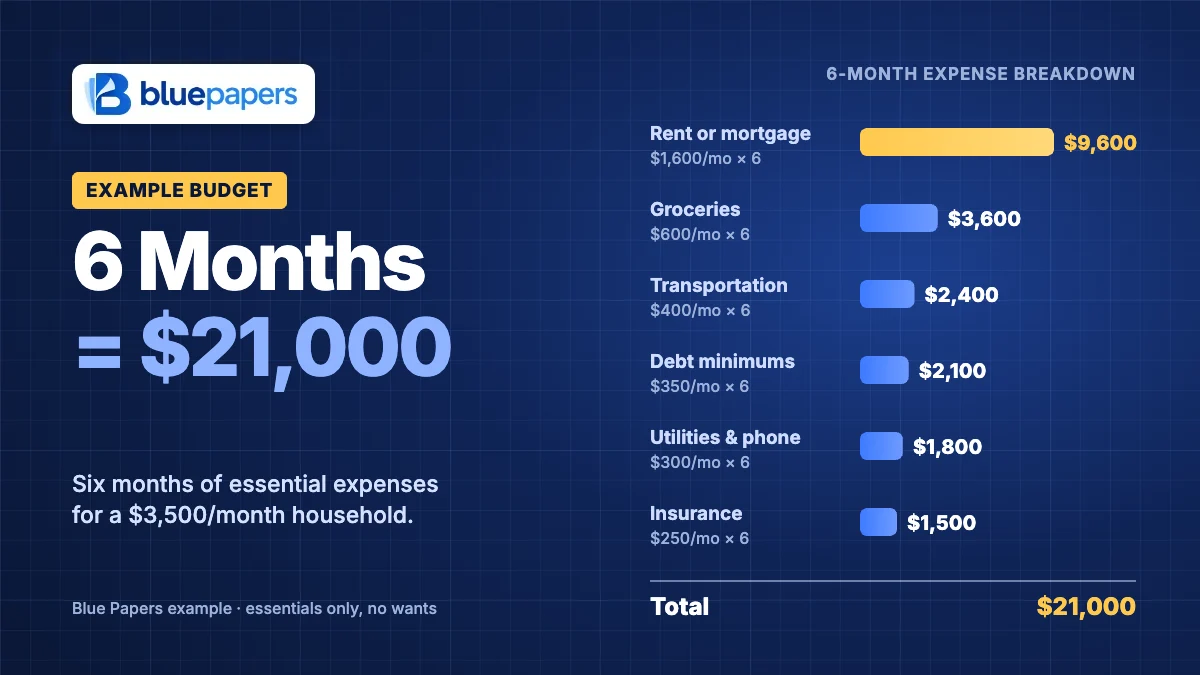
To see how the math works, take a household that spends $3,500 a month on essentials. Multiply each category by six and the full target comes to $21,000.
| Essential expense | Per month | × 6 months |
|---|---|---|
| Rent or mortgage | $1,600 | $9,600 |
| Groceries | $600 | $3,600 |
| Transportation | $400 | $2,400 |
| Debt minimum payments | $350 | $2,100 |
| Utilities & phone | $300 | $1,800 |
| Insurance | $250 | $1,500 |
| Total | $3,500 | $21,000 |
Notice what’s missing: restaurants, streaming services, vacations and new clothes. In a real emergency you would cut those first, so they don’t belong in the target. That keeps the number lower and much easier to reach. Our emergency fund calculator asks for essentials only for exactly this reason.
If $21,000 feels impossible right now, remember that the emergency fund calculator gives you a finish line, not a starting requirement. Every month of expenses you save is a month of breathing room you didn’t have before.
What Counts as an Essential Expense?
Getting this number right is the most important step in using any emergency fund calculator. Too high and your target feels out of reach. Too low and you’ll run out of money when you need it most. A simple test: would you still have to pay it if you lost your job tomorrow?
Include:
- Rent or mortgage payment, including property tax and insurance if they’re escrowed
- Utilities, internet and a basic phone plan
- Groceries (not restaurants)
- Transportation: car payment, insurance, gas, transit passes
- Health insurance premiums and regular prescriptions
- Minimum payments on credit cards, student loans and other debt
- Childcare you would still need while job hunting
- Any other bill that would go to collections if unpaid
Leave out:
- Dining out and takeout
- Travel, hobbies and entertainment
- Extra debt payments above the minimum
- Retirement and investment contributions (you would pause these in a crisis)
- Subscriptions you could cancel in a day
Tip: pull the last three months of bank and card statements and average the essentials. Most people underestimate this number by 10% to 20% on their first try, so round up when you enter it in the calculator. Then enter the result in the emergency fund calculator above.
Where to Keep Your Emergency Fund
An emergency fund has two jobs: be there instantly, and never lose value. That rules out the stock market and crypto. It also rules out your everyday checking account, where the money is too easy to spend and usually earns almost nothing.
- High-yield savings account (best for most people): online banks often pay several times the interest of a typical big-bank savings account, and you can move money to checking in a day or two.
- Money market account: similar rates, sometimes with check-writing or a debit card for faster access.
- A short CD or Treasury bill ladder (for larger funds): once you have 3 months in savings, you can put the rest in short-term CDs or T-bills that mature every few months. Only use money you won’t need on the same day.
Whatever you choose, make sure the bank is FDIC-insured (or NCUA-insured for credit unions). The FDIC protects up to $250,000 per depositor, per insured bank, for each account ownership category, which covers almost any emergency fund.
Keep the fund at a different bank from your checking account if you’re tempted to dip into it. A one- or two-day transfer delay is a feature, not a bug: it gives you time to ask whether this is truly an emergency. Once you know your number from the emergency fund calculator, open the account and set up the transfer the same day.
How to Build an Emergency Fund Fast
Building a full fund can take a year or two, and that’s normal. The trick is to break it into milestones so you feel progress every month. Here’s the order we recommend:
- Save a $1,000 starter fund first. This covers most car repairs and small medical bills, and stops the cycle of putting surprises on a credit card.
- Keep getting your full employer 401(k) match. It’s an instant 50% to 100% return, so don’t pause it to build your fund faster.
- Build to one month of essentials, then pay down any credit card debt above roughly 8% interest.
- Automate the rest. Set a transfer for the day after payday. Even $200 a month adds up to $2,400 a year.
- Send windfalls straight to the fund: tax refunds, bonuses, cash gifts and side-hustle income can cut your timeline in half.
- Finish your full target, then redirect the monthly transfer to retirement or other goals.
Want to see how your savings compare with other households your age? Check our guide to average savings by age. The median household under 35 keeps only about $5,400 in cash, so if you reach 3 months of expenses, you’re ahead of most people.
Plug your monthly savings amount into the emergency fund calculator above to see exactly how many months it will take to reach your target. Small increases make a big difference: raising your transfer from $300 to $400 a month cuts a $12,000 gap from 40 months to 30.
5 Emergency Fund Mistakes to Avoid
Even people who use an emergency fund calculator and set a smart target can trip over these common mistakes.
1. Counting your whole budget instead of essentials. Plugging every dollar you spend into an emergency fund calculator inflates the target, sometimes by 30% or more. A bigger number is harder to reach, and many people give up. Use essentials only, as shown in the breakdown above.
2. Keeping the money in checking. Cash that sits next to your debit card gets spent. It also earns almost nothing. Moving it to a separate high-yield savings account protects it from everyday spending and lets it grow.
3. Investing it in the stock market. Markets often fall at the same time layoffs rise. If your fund drops 20% just when you lose your job, it can’t do its one job. Keep emergency money in cash or cash-like accounts.
4. Never updating the target. A new baby, a mortgage or a switch to freelance work can double how much you need. Rerun the emergency fund calculator at least once a year, and after any big life change, so your fund keeps pace with your life.
5. Raiding it for things that aren’t emergencies. Holiday gifts, car registration and annual insurance premiums are predictable. Save for them in a separate “sinking fund” so your emergency money is still there when something truly unexpected happens.
If you’re also weighing a big housing decision, keep your fund separate from your down payment savings. Our Rent vs Buy Calculator shows how long you would need to stay in a home for buying to pay off, and your emergency fund calculator result tells you how much cash to keep on top of that.
When to Use (and Not Use) Your Emergency Fund
An emergency fund only works if you use it for real emergencies. A good rule: it must be unexpected, necessary and urgent.
Good reasons to use it:
- Job loss or a big cut in income
- Medical or dental bills you can’t delay
- Urgent car repairs you need to get to work
- Emergency home repairs: a broken furnace, a leaking roof
- Emergency travel for a family crisis
Not emergencies:
- Holidays, birthdays and annual bills you know are coming (save for those in a separate account)
- Vacations and sales
- A down payment on a house. Buying a home shouldn’t drain your safety net. See How Much House Can I Afford? to plan a purchase that leaves your fund intact.
- Investing because the market dropped
After you use the fund, rebuild it before restarting other goals. Run the emergency fund calculator again whenever your life changes: a new job, a baby, a home purchase or a big raise all move your target.
Emergency Fund Calculator FAQ
Is $10,000 too much for an emergency fund?
No. For most people $10,000 is not enough, let alone too much. It covers about 3 months if your essentials cost $3,300 a month, which is the minimum target for a two-income household.
Is $20,000 enough for an emergency fund?
For many single-income households, yes. $20,000 covers about 6 months of essentials at roughly $3,300 a month. If your essentials are higher, or your income is variable, you may need more.
Is $30,000 a good emergency fund amount?
It’s a strong fund for most households. $30,000 covers 6 months at $5,000 a month, or about 9 months at $3,300. That’s a good fit for self-employed people and families with one income.
Is $50,000 too much for an emergency fund?
It can be. If $50,000 is more than 12 months of your essential expenses, the extra cash is losing ground to inflation. Keep your full target in savings and consider investing the rest, unless you’re saving for a near-term goal like a home.
Should I build an emergency fund or pay off debt first?
Do both in order: a $1,000 starter fund, then your employer match, then high-interest debt, then the full emergency fund. Without a small cushion, the next surprise just goes back on the credit card.
Does my emergency fund count toward my net worth?
Yes. Cash is an asset, so it adds to your net worth like any other savings. See how your total compares in our net worth by age guide.
Is 3 months or 6 months better?
Six months is safer, and it’s the better default if you have one income or dependents. Three months is reasonable for a two-income household with stable jobs. Use the emergency fund calculator to see where your situation falls.
How often should I update my emergency fund target?
Check it at least once a year, and any time your life changes in a big way: a new job, a move, a new baby, a home purchase or a switch to self-employment. Your essential expenses tend to creep up with inflation, so a target that was right two years ago may now cover only five months instead of six. Rerunning the emergency fund calculator takes less than a minute, and it tells you whether to keep saving or redirect the extra money. Many people pair this with their annual budget review, so the emergency fund calculator becomes part of a simple yearly money checkup.
The bottom line: an emergency fund is what turns a crisis into an inconvenience. Use the emergency fund calculator to set your target, start with $1,000, automate the rest and keep the money somewhere safe and boring. You’ll sleep better long before you reach the finish line.
Read next
- Is a High-Yield Savings Account Worth It?
- How Much to Save for Christmas
- 50/30/20 Rule
- Credit Card Minimum Payment Calculator
Data last checked September 26, 2026. This article is for educational purposes only and is not financial advice.
Sources: U.S. Bureau of Labor Statistics, Table A-12: Unemployed persons by duration of unemployment (August 2026) · FDIC, Deposit Insurance · Federal Reserve, Survey of Consumer Finances
Leave a Reply