
Most advice on how much to save for Christmas divides your budget by the months left until December 25. That math is wrong twice. You don’t need the money on Christmas Day; you need it when you shop, which for most people is before mid-December. And you don’t get paid in months. You get paid in paychecks, and depending on how your employer’s calendar falls, you may have three, five, or six of them left in 2026.
The difference is bigger than it looks. Two people with the same salary and the same $890 budget can face per-paycheck targets of $148 and $178, just because one got paid on October 2 and the other on October 9. Wait until after Thanksgiving and the same budget needs $445 a check, or all $890 out of one paycheck. Here’s the paycheck math, what skipping it costs, and a calculator that counts your actual paydays.
Table of Contents
How Much to Save for Christmas, Per Paycheck
The National Retail Federation’s 2025 survey put the average holiday budget at $890.49 per person: $627.93 on gifts and $262.56 on food, decorations, cards and other seasonal items. Travel isn’t included. If that’s roughly your budget and you start with the first payday in October, here’s how much to save for Christmas from each paycheck to have the money by December 15:
| How you’re paid | Paydays Oct 1 – Dec 15 | Save per paycheck | If you start after Thanksgiving |
|---|---|---|---|
| Weekly (Fridays) | 11 | $81 | $297 (3 checks) |
| Every two weeks, first paid Oct 2 | 6 | $148 | $445 (2 checks) |
| Every two weeks, first paid Oct 9 | 5 | $178 | $890 (1 check) |
| Twice a month (15th and last day) | 5 | $178 | $445 (2 checks) |
| Monthly (last day) | 2 | $445 | $890 (1 check) |
Budget figures are rounded to $890. “After Thanksgiving” counts paydays from November 27 through December 15. Your own budget may be higher or lower than the average, so treat the table as a starting point and use the calculator below with your numbers.

Count Paychecks, Not Months
“Save $300 a month for three months” sounds like a plan. But most paychecks don’t arrive monthly. In the Bureau of Labor Statistics’ latest count, 70% of private businesses pay weekly (27%) or every two weeks (43%). Only 10% pay monthly. So the number of paychecks you actually receive between now and your shopping deadline is what decides how much to save for Christmas from each one.
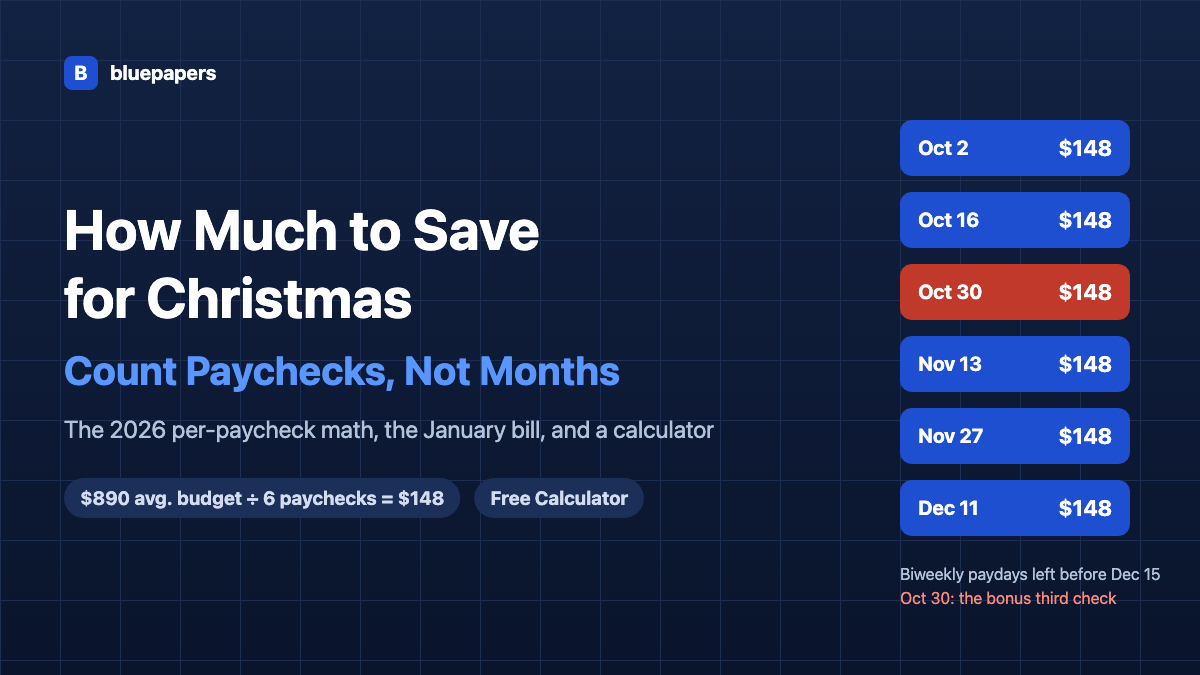
The biweekly case is where the calendar plays tricks. If your Friday paydays in 2026 fell on October 2, you have six paydays before December 15: October 2, 16 and 30, November 13 and 27, and December 11. If they fell on October 9, you have five: October 9 and 23, November 6 and 20, and December 4. Same salary, same budget, $30 more per check for the second group.
The Third Paycheck in October
For the October 2 group, there’s a bonus: October 2026 has three paydays. Most people budget rent, utilities and car payments around two checks a month, so the third one arrives with no bills attached to it. Moving a big piece of that check straight into a holiday fund can cover much of the average budget in one step, without touching your regular monthly spending. The other biweekly group already had its three-payday months this year, in January and July.
If you’re paid twice a month on the 15th and the last day, there’s no third check, but your schedule is predictable: five paydays from October 15 to December 15. Monthly earners have the hardest math. If you’re paid at the end of the month, only October 31 and November 30 land before mid-December, so the full budget has to come out of two checks.
The 1909 Idea That Still Works
Banks figured this out more than a century ago. According to the Library of Congress, the Carlisle Trust Company in Pennsylvania started the first Christmas savings club in 1909. Members opened an account in December, made small deposits every week for 50 weeks, and got a check in November — before the shopping started, not on Christmas morning.
Three parts of that design are worth copying, even if you never open a club account:
- Deposits matched the pay cycle. Weekly wages, weekly deposits. Your transfer should hit the day after each payday, not on an arbitrary date.
- The money was out of reach. Club savings sat in a separate account that was awkward to touch early. A separate savings account that doesn’t show up in your checking app does the same job today.
- The payout came early. November, not December 24. Set your deadline for when you actually shop.
Classic Christmas club accounts still exist at many credit unions and community banks, but they often pay little or no interest and may charge a fee for early withdrawals. A high-yield savings account with a nickname like “December” usually does the job better. If you already keep an emergency fund, keep the holiday money in a separate bucket so one doesn’t quietly eat the other.
Christmas Savings Calculator
To see how much to save for Christmas on your own pay schedule, enter your holiday budget, anything you’ve already set aside, how often you’re paid and your next payday. The calculator counts the paychecks left before your deadline, shows what each one needs to cover, what happens if you wait four weeks, and what the same amount would cost on a credit card paid at the minimum.
Paydays are counted from your next payday through the “needed by” date, including both. Twice-a-month pay is assumed to land on the 15th and the last day of the month; monthly pay repeats on the same day of the month as your next payday. Weekend and bank-holiday shifts are ignored. The credit card scenario assumes a 22% APR and a minimum payment of 1% of the balance plus interest, with a $35 floor, and no new charges. Estimates only, not financial advice. Nothing you enter leaves your browser.
What Skipping the Plan Costs: The January Bill
The alternative to saving is borrowing, and plenty of people take it. In LendingTree’s survey after the 2025 holidays, 37% of Americans said they took on holiday debt, averaging $1,223 — up from $1,181 a year earlier. 63% of them expected to need three months or more to pay it off, and 40% were paying an interest rate of 20% or higher.
Here’s what that average balance costs on a card with a 22% APR:
| How you pay off $1,223 | Monthly payment | Time to pay off | Total interest |
|---|---|---|---|
| Minimum payment only | Starts at $35 | 57 months | $749 |
| Fixed payment over 5 months | $258.22 | 5 months | $68 |
| Fixed payment over 3 months | $422.70 | 3 months | $45 |
| Saved ahead, paid in full | — | — | $0 |
The minimum payment assumes 1% of the balance plus interest, with a $35 floor, and no new charges. At that pace, a balance from Christmas 2025 isn’t gone until the fall of 2030, and the interest adds about 61% to the cost of every gift. Our credit card minimum payment calculator shows the same math for any balance. Seen per paycheck, $148 every two weeks starting now is a lot less painful than $35 a month for almost five years.
Buy now, pay later plans aren’t a way around this. LendingTree found 45% of gift-givers used one for at least one purchase. Pay-in-four plans usually charge no interest, but they split the bill into installments that land in December and January, on top of everything else. That’s borrowing from your next few paychecks, not saving from your last few.
If the Per-Paycheck Number Is Too High
If the calculator’s answer to how much to save for Christmas is $178 a check and your budget has room for $90, don’t borrow the gap. Shrink the budget so it fits the paychecks you have:
- Write the list with prices first. Put a dollar amount next to every name before you shop, and make the total match what your paychecks can fund.
- Split the two halves. In NRF’s numbers, nearly 30% of holiday spending goes to food, decorations and cards, not gifts. Reusing decorations and keeping the menu simple is often the easiest cut.
- Suggest a family gift exchange. Drawing names so everyone buys one good gift instead of ten small ones often lowers the total and the stress.
- Use the categories you already have. If you follow the 50/30/20 rule, holiday spending belongs in your 30% “wants.” Cutting a few restaurant meals in October and November funds part of it without new money.
Leave Loading and Christmas Hampers
In Australia, Christmas lands in the middle of summer, and many workplaces close between Christmas and New Year. Lots of people take annual leave then, and workers covered by many awards and agreements get a 17.5% leave loading on top of their regular pay for that leave. The idea is simple: the holiday is partly funded by a separate stream of money, not squeezed out of regular pay. The Christmas club also lives on there in another form. Hamper companies let families pay a small amount every week through the year for a box of food and treats delivered in December — the 1909 idea in a cardboard box.
In Korea, Christmas is a small, couples-focused holiday. The big spending seasons are 추석 (Chuseok) in the fall and 설날 (Seollal), the Lunar New Year: gift sets for relatives, travel back to hometowns, and cash for children. Many Korean employers pay a 명절 상여금, a holiday bonus, right before those holidays, so the spending is funded before it starts. Most American workers don’t get a December bonus they can count on. A holiday fund built from your own paychecks gives you the same effect.
Set It Up This Week
- Pick your number. Total last year’s holiday spending from your card and bank statements, or start with the $890 average and adjust.
- Pick your deadline. December 15 works for most people. If you shop on Black Friday, use November 27.
- Count your paydays. Use the calculator above. Divide what’s left to save by the number of checks. That’s how much to save for Christmas from each one.
- Automate the transfer. Schedule it for the day after each payday, into a separate savings account.
- Shop with the fund, not the card. If you use a credit card for rewards or purchase protection, pay the statement in full from the holiday fund when it arrives.
Once the holidays are over, consider leaving the transfer on at a smaller amount. Saving for next Christmas starting in January means 26 biweekly or 24 twice-a-month paychecks instead of five or six, and an $890 budget drops to about $34 or $37 a check.
Frequently Asked Questions
How much should I save for Christmas?
Start with your total holiday budget, subtract what you’ve already set aside, and divide by the number of paychecks left before you shop. For the average 2025 budget of about $890, that’s roughly $148 per paycheck if you’re paid every two weeks starting October 2, $178 if you’re paid twice a month, and $81 if you’re paid weekly.
How much does the average American spend on Christmas?
The National Retail Federation’s 2025 survey found consumers planned to spend $890.49 per person on the winter holidays: $627.93 on gifts and $262.56 on food, decorations, greeting cards and other seasonal items. Travel isn’t included in that figure.
When should I start saving for Christmas?
The best time is January, when you have 24 to 26 paychecks ahead of you and an $890 budget works out to about $34 to $37 a check. If you’re starting in the fall, start with your very next payday. Every two weeks you wait removes a paycheck and raises the amount each remaining one has to cover.
Are Christmas club accounts worth it?
They can help if you need the money locked away, since many make early withdrawals awkward or charge a fee. But they often pay little or no interest. A separate high-yield savings account with an automatic transfer after each payday usually does the same job and earns more.
Is it bad to put Christmas on a credit card?
Not if you pay the statement in full. The problem is carrying the balance. At a 22% APR, the average 2025 holiday debt of $1,223 takes 57 months and about $749 in interest to clear with minimum payments, versus about $45 in interest if you pay it off in three months.
How much to save for Christmas isn’t really a question about Christmas. It’s a question about how many paydays you have left, and that number shrinks every two weeks. Count them today, set the transfer, and let the January statement be boring.
Related guides
Updated October 2, 2026. Written by Jun, who is not a licensed financial advisor. Payday counts assume Friday paydays for weekly and biweekly pay and ignore weekend and holiday shifts. Credit card figures assume a 22% APR and no new charges. Calculator results are estimates for planning only.
Sources: National Retail Federation, 2025 Holiday Spending Survey · LendingTree, holiday debt survey (December 2025) · Library of Congress, “Saving for the Holidays the Old Fashioned Way” (2019) · U.S. Bureau of Labor Statistics, length of pay periods in private establishments · Fair Work Ombudsman (Australia), annual leave loading
Leave a Reply