
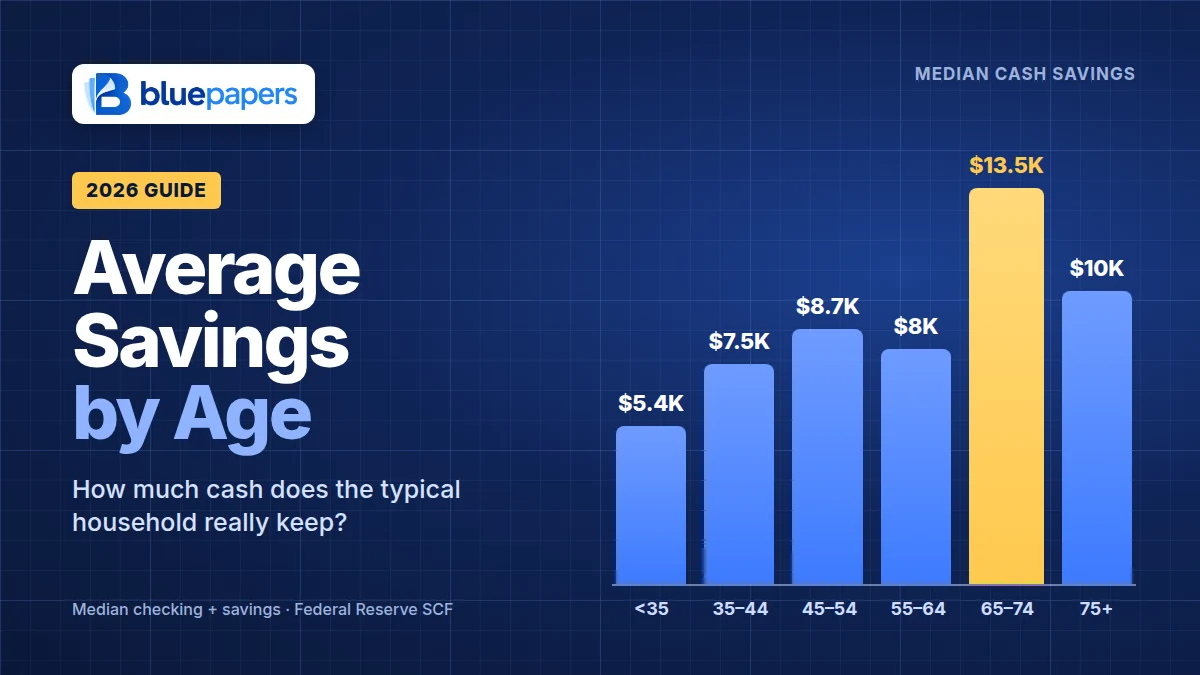
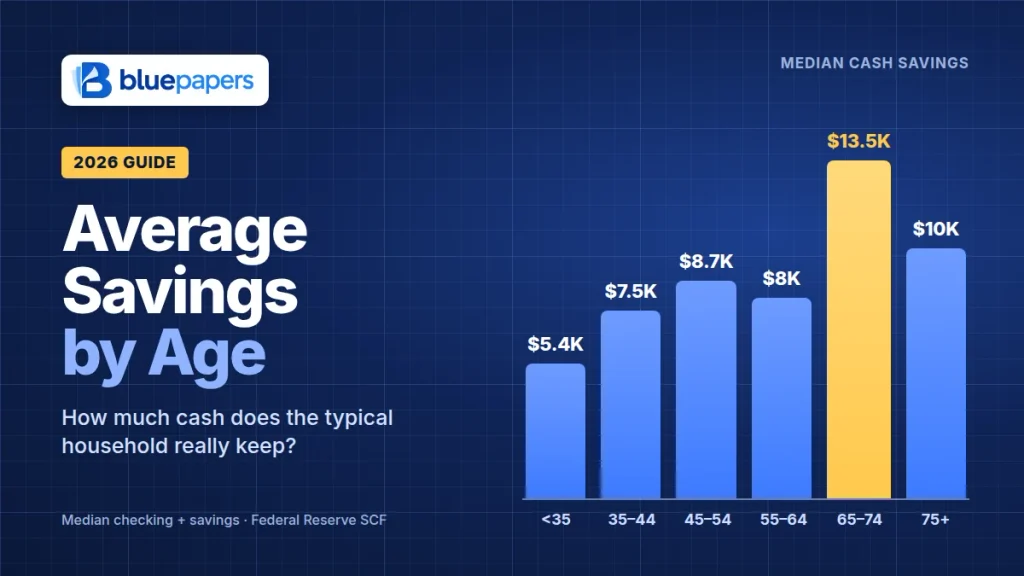
Average savings by age: The typical American household under 35 has about $5,400 in checking, savings and money market accounts. For ages 35–44 it’s $7,500, and it peaks at about $13,500 for ages 65–74. These are median figures from the Federal Reserve’s latest Survey of Consumer Finances.
Average savings by age can look surprisingly low. Most households have less than three months of expenses in cash. The average (mean) balances you often see quoted, $20,000 to $100,000, are pulled up by a small number of very wealthy households.
Table of Contents
Average savings by age: mean vs. median
Cash savings (checking, savings, money market and similar accounts):
| Age | Median | Average |
|---|---|---|
| Under 35 | $5,400 | $20,540 |
| 35–44 | $7,500 | $41,540 |
| 45–54 | $8,700 | $71,130 |
| 55–64 | $8,000 | $72,520 |
| 65–74 | $13,500 | about $100,000 |
| 75+ | $10,000 | about $83,000 |
Retirement savings (401(k), IRA and similar), for households that have an account:
| Age | Median | Average |
|---|---|---|
| Under 35 | $18,880 | $49,130 |
| 35–44 | $45,000 | $141,520 |
| 45–54 | $115,000 | $313,220 |
| 55–64 | $185,000 | $537,560 |
| 65–74 | $200,000 | $609,230 |
| 75+ | $130,000 | $462,410 |
Source: Federal Reserve, 2022 Survey of Consumer Finances (2022 dollars). Results from the 2025 survey are expected in late 2026, and we’ll update these tables when they come out.
Two things to notice:
- Cash barely grows with age. From 35 to 64, the median cash balance stays between $7,500 and $8,700. People put their growing wealth into retirement accounts and home equity, not into checking.
- Many households have no retirement account at all. Only about half of households under 35, and about 6 in 10 at ages 35–54, have one. The retirement table covers only the households that do.
How to interpret average savings by age
The median is the household exactly in the middle. The average adds up everyone’s money and divides by the number of households, so a few very wealthy families pull it far above what most people have. Across all ages, the average cash balance is nearly eight times the median.
So if you’re 40 with $10,000 in savings, you’re ahead of the typical household your age, even though you’re far below the $41,540 average.
How much should you actually have saved?
Average savings by age describes a group; your age group’s median tells you what is typical. It doesn’t tell you what’s enough. Use these three targets instead:
1. Emergency fund: 3 to 6 months of essential expenses
Essential expenses are what you’d have to pay even after losing your job: housing, food, utilities, insurance, transportation and minimum debt payments.
| Monthly essential expenses | 3-month target | 6-month target |
|---|---|---|
| $2,500 | $7,500 | $15,000 |
| $3,500 | $10,500 | $21,000 |
| $5,000 | $15,000 | $30,000 |
Aim for 3 months if you have a stable job and a two-income household. Aim for 6 months if you’re self-employed, work on commission, or are the sole earner.
2. Retirement: a multiple of your salary
Fidelity’s widely used milestones:
| By age | Retirement savings |
|---|---|
| 30 | 1× your salary |
| 40 | 3× your salary |
| 50 | 6× your salary |
| 60 | 8× your salary |
| 67 | 10× your salary |
On a $75,000 salary, that means about $75,000 by 30 and $225,000 by 40. It’s a demanding target. Most people are behind, and the next section explains how to catch up.
3. Savings rate: 15% or more of gross income
This includes any employer match. If you start in your 20s, saving 15% of your income every year is generally enough to reach the milestones above. If you start later, you’ll need to save more.
Check your own numbers. This calculator puts all three targets side by side: how your cash compares with others your age, how many months of essentials it covers, and how your retirement savings stack up against the salary-multiple target for your exact age.
Age-group medians and averages come from the Federal Reserve’s 2022 Survey of Consumer Finances (2022 dollars), the same figures as the tables above; retirement figures are for households that have a retirement account. The retirement target is Fidelity’s salary multiple (1x by 30, 3x by 40, 6x by 50, 8x by 60, 10x by 67), interpolated for your exact age. Estimates only, not financial advice. Nothing you enter leaves your browser.
Where to keep your savings
When reviewing average savings by age, separate where your money is held from how much you have saved.
- Emergency fund: a high-yield savings account (HYSA). It keeps the money safe and available while earning far more interest than a typical checking account. Compare account fees, access restrictions, and deposit insurance before choosing an account.
- Retirement: a 401(k) (especially up to the employer match) and an IRA or Roth IRA.
- Goals 1–5 years away (a down payment or a car): a HYSA or CDs. Don't put money you'll need soon in the stock market.
Keeping large amounts in a checking account that pays almost nothing means you lose value to inflation every year.
Behind? A 3-step catch-up plan
Step 1: Build a starter cushion of $1,000 to $2,000
Before anything else, save enough to cover a car repair or a medical bill without using a credit card. Automate a small weekly transfer, even $25, to a separate savings account.
Step 2: Get your employer match, then pay off high-interest debt
- Contribute enough to your 401(k) to get the full employer match. It's an immediate 50% to 100% return on your money.
- Then pay off credit cards and any debt above roughly 8% interest.
Step 3: Finish your emergency fund, then raise your retirement savings
- Build your emergency fund to 3 months of expenses.
- Raise your retirement contribution by 1% to 2% of pay every six months until you reach 15%. Small increases are easier to stick with.
- Put at least half of every raise or bonus toward savings.
Habits that raise your savings without willpower
- Pay yourself first: schedule the transfer to savings on payday, before you spend anything.
- Split your direct deposit: most employers can send part of each paycheck straight to a savings account.
- Name your accounts ("Emergency Fund", "House 2028"). People tend to leave money alone when it has a specific purpose.
- Review subscriptions every quarter. Cancelling two or three unused services can free up $30 to $60 a month.
- Save windfalls: tax refunds, bonuses and cash gifts.
Average savings by age: frequently asked questions
How much does the average 30-year-old have in savings?
For households under 35, the median is about $5,400 in cash accounts and $18,880 in retirement accounts (among households that have one). A better target at 30 is 3 months of expenses in cash and about 1× your salary in retirement savings.
Is $10,000 in savings good?
It's above the median for every age group under 65. Whether it's enough depends on your expenses: $10,000 covers about 3 months if you spend $3,300 a month on essentials.
How much should I have saved by 40?
A common benchmark is 3× your salary for retirement, plus 3 to 6 months of expenses in an emergency fund.
Should I save or pay off debt first?
Do both in order: a small starter cushion first, then the employer match, then high-interest debt, then the full emergency fund.
Does savings include my 401(k)?
In everyday language, "savings" usually means cash you can get to quickly. Retirement accounts are counted separately, which is why this article shows both.
If you are still deciding
- Emergency Fund Calculator
- Is a High-Yield Savings Account Worth It?
- 401(k) Balance by Age
- How Much Should I Save for Retirement?
Data last checked September 25, 2026. This article is for educational purposes only and is not financial advice.
Sources: Federal Reserve, Survey of Consumer Finances · Experian, Average Savings by Age (2022 SCF data) · NerdWallet, Average Retirement Savings by Age · WealthyPot, Average Savings by Age
Related reading
For a broader view beyond average savings by age, read Net Worth by Age: Where Do You Stand?. If you are saving for a down payment, explore How Much House Can I Afford? to compare housing budgets.
Leave a Reply