
The debt avalanche vs snowball question has two camps. Economists say pay the highest interest rate first, because that is the math. Popular money coaches say pay the smallest balance first, because that is how people actually stick with it. Both camps are partly right, and the useful question is how much the math costs you in your case.
So instead of repeating the usual pros-and-cons list, I built a realistic five-debt household, ran both methods month by month, and measured the gap. Then I asked a question most articles skip: how much extra motivation would the snowball need to buy before it wins? You can run the same test on your own debts with the calculator below.
What’s in This Guide
The Debt Snowball Method
You list your debts from the smallest balance to the largest, ignoring interest rates. You pay the minimum on everything, then throw every extra dollar at the smallest balance. When it’s gone, its payment “rolls” into the next smallest, so the amount you attack each month keeps growing, like a snowball rolling downhill.
The debt snowball’s appeal is speed of visible progress. Clearing an $850 store card in three months feels like a real win, and wins keep people going.
The Debt Avalanche Method
You list your debts from the highest interest rate to the lowest. Same mechanics: minimums on everything, extra money at the top of the list, then roll each freed payment down to the next.
With the debt avalanche, the most expensive balance shrinks first, so you pay less interest overall and are never slower to finish. The catch is that your first big target may also be a large balance, so the first “paid off” moment can take many months.
Debt Avalanche vs Snowball: We Ran the Numbers
Here’s the test household. The card rates reflect today’s market: the Federal Reserve’s latest G.19 consumer credit report puts the average rate on credit card accounts that pay interest at 22.15% for the second quarter of 2026.
| Debt | Balance | APR | Minimum |
|---|---|---|---|
| Store card | $850 | 29.99% | $35 |
| Card A | $3,400 | 21.99% | $102 |
| Card B | $6,200 | 27.49% | $186 |
| Personal loan | $4,800 | 11.5% | $160 |
| Car loan | $11,500 | 7.9% | $365 |
| Total | $26,750 | $848 |
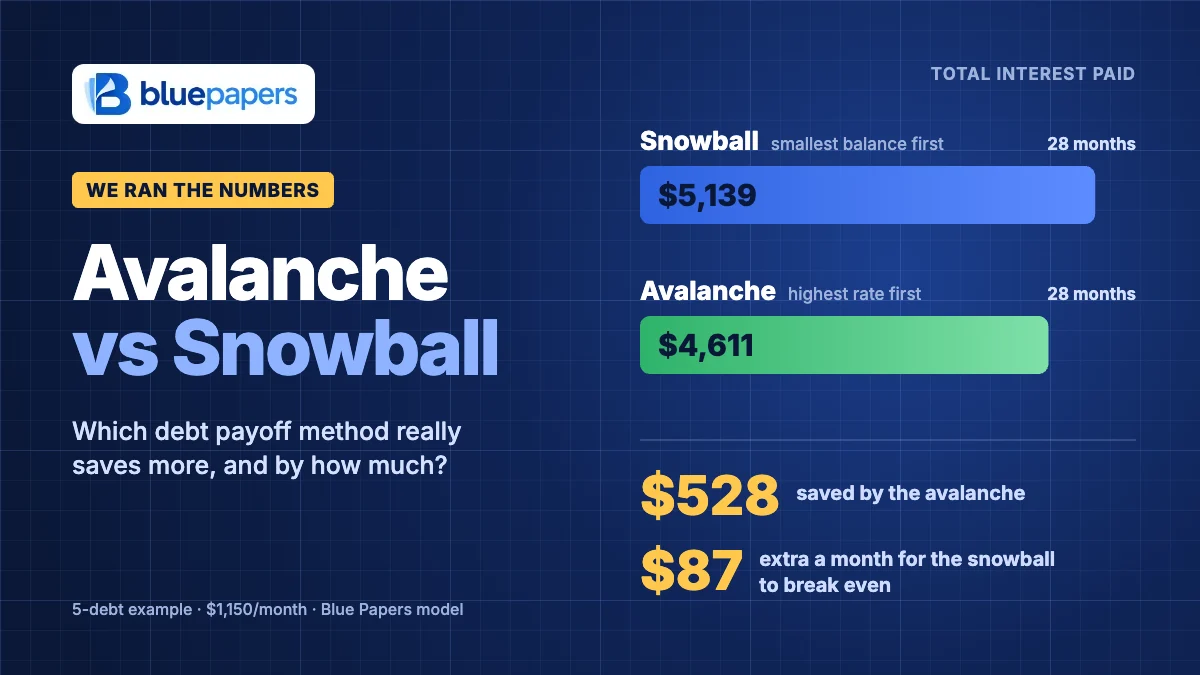
The household can put $1,150 a month toward debt, $302 more than the minimums. Here’s what happened:
| Snowball | Avalanche | |
|---|---|---|
| Debt-free in | 28 months | 28 months |
| Total interest | $5,139 | $4,611 |
| First debt gone | Month 3 | Month 3 |
| Debts gone by month 17 | 3 of 5 | 2 of 5 |
Three things stood out.
1. The gap was smaller than the debate suggests. The avalanche saved $528, about 2% of the starting debt, and both finished in the same month. Why so close? Because the smallest debt here, the store card, also has the highest rate, so both methods start in the same place. That overlap is common: store cards and small department-store accounts tend to carry the highest APRs.
2. The debt snowball front-loads the good feelings. By month 17 the snowball household had closed three accounts and the avalanche household only two. The avalanche spent more than a year grinding down a $6,200 card before its second win.
3. The price of motivation has a number. I kept adding money to the debt snowball plan until it matched the avalanche’s total interest. The answer: $87 more per month. If paying off small balances quickly would push you to find an extra $87 a month, by cooking at home or picking up a shift, the snowball wins outright. If it wouldn’t, the avalanche is the cheaper plan.
The monthly budget changes the picture more than people expect:
| Monthly payment | Snowball interest | Avalanche interest | Avalanche saves | Extra/month snowball needs to break even |
|---|---|---|---|---|
| $950 | $7,263 | $6,769 | $494 | $45 |
| $1,150 | $5,139 | $4,611 | $528 | $87 |
| $1,500 | $3,539 | $3,110 | $429 | $161 |
| $2,000 | $2,497 | $2,189 | $308 | $247 |
The pattern: the dollar gap stays in a fairly narrow range, roughly $300 to $530, but the break-even bar rises steeply with the budget. A household paying $950 a month needs only $45 of extra motivation for the snowball to catch up, while one paying $2,000 would need $247, because it is already moving fast. All figures assume interest is charged monthly at APR ÷ 12 and minimums stay at today’s amounts.
Enter up to six debts. Leave a row blank to skip it.
| Debt | Balance ($) | APR (%) | Min. payment ($) |
|---|
Interest is charged monthly at APR ÷ 12. Minimum payments are held at today’s amounts, and every payment freed by a paid-off debt rolls into the next target. Real card minimums fall as balances shrink, so treat results as estimates. Nothing you enter leaves your browser.
Pros of the Debt Snowball and Advantages of the Debt Avalanche
Research backs both sides, which is why the argument never ends.
On the debt snowball’s side. Marketing researchers David Gal and Blakeley McShane studied thousands of real debt-settlement customers and found that people who closed out more individual accounts were more likely to eliminate their debt entirely, even after accounting for how many dollars they paid. Closing accounts, not just shrinking dollars, predicted success. A 2016 study by Remi Trudel and colleagues, published in Harvard Business Review, pointed the same way: people felt more progress and stayed more motivated when they focused on paying off one account at a time.
On the debt avalanche’s side. Economists Alexander Brown and Joanna Lahey found that small early victories do boost effort, but only modestly, and that the boost can’t make up for large differences in interest rates. When one of your debts charges far more than the others, the avalanche’s savings tend to swamp any motivational gain.
Here’s how I’d choose:
- Pick the debt avalanche if your rates are far apart (say, a 29% card next to a 7% car loan and the big balance is on the expensive card), or if you already have a savings habit and don’t need quick wins.
- Pick the debt snowball if you’ve started and quit debt plans before, if you have several small balances you could clear within a few months, or if your rates are all within a few points of each other, where the cost difference is tiny.
- Try a hybrid if you can’t decide: knock out any balance you can clear in 90 days first for a quick win, then switch to highest rate first. In our test household, that rule picks the same first target as both methods.
Whichever you choose, the method matters less than the monthly amount. In our example, raising the payment from $1,150 to $1,500 cut total interest by about $1,500 and saved 7 or 8 months, roughly three times the gap between the two methods. Every freed-up dollar is the real accelerator when you pay off debt.
One more tip: as balances fall, watch your debt-to-income ratio fall with them. Clearing a car loan or card payment can move you into a better mortgage bracket, and our DTI guide and calculator shows exactly how much.
Frequently Asked Questions
How do I pay off $30,000 in debt in 1 year?
At a 22% interest rate, clearing $30,000 in 12 months takes about $2,808 a month, and roughly $3,700 of what you pay over the year is interest. At 15% it is about $2,708 a month. Most households can only do that by combining a strict budget, extra income and, where it makes sense, a lower-rate consolidation loan or a 0% balance transfer.
Does Dave Ramsey recommend debt snowball or avalanche?
Dave Ramsey recommends the snowball. It is Baby Step 2 in his plan: pay off all debts except the mortgage from smallest to largest balance, regardless of interest rate.
Why does Dave Ramsey recommend the snowball?
He argues that personal finance is mostly about behavior, and that quick wins keep people motivated long enough to finish. The research on small victories supports that idea, though it also shows the motivational boost has limits when rates are far apart.
What debts should I pay off first?
Start with anything past due, because late fees and credit damage cost more than interest. After that, the avalanche says highest rate first and the snowball says smallest balance first. Keep paying at least the minimum on everything, and keep a small emergency fund so a surprise bill does not send you back to the card.
Should you choose the debt snowball or debt avalanche if your rates are similar?
The snowball. When rates are within a few points of each other, the interest difference is small, and the faster wins are worth more than the few dollars you might save.
The honest answer to debt avalanche vs snowball is the one that keeps you paying. Run your own numbers above, look at the break-even figure, and ask yourself whether quick wins would really be worth that much to you each month.
Keep reading on Bluepapers
Updated September 26, 2026. Written by Jun, who is not a licensed financial advisor. The example household is illustrative. Results depend on your balances, rates, fees and how your lenders calculate interest and minimum payments. This article is for educational purposes only and is not financial advice.
Sources: Federal Reserve G.19 Consumer Credit (September 2026 release) · Gal and McShane, “Can Small Victories Help Win the War? Evidence from Consumer Debt Management,” Journal of Marketing Research (2012) · Brown and Lahey, “Small Victories: Creating Intrinsic Motivation in Task Completion and Debt Repayment,” NBER Working Paper 20125 · Trudel et al., “Research: The Best Strategy for Paying Off Credit Card Debt,” Harvard Business Review (2016)
Leave a Reply