
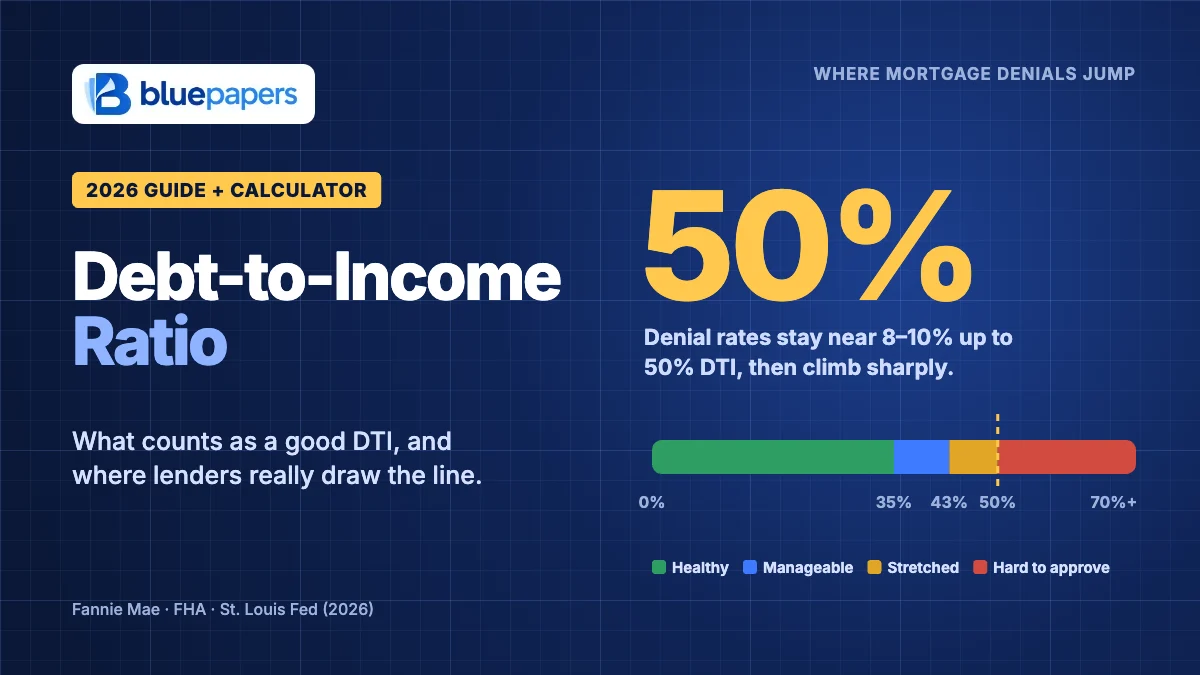
Your debt to income ratio is the share of your gross monthly income that goes to debt payments. Lenders look at it before almost anything else, including your credit score, because it answers one plain question: after this new loan, can you still pay everything on time?
I first noticed how much weight this number carries while comparing how home loans work in three countries. Korea, Australia and the US all measure debt against income, but each does it differently, and the US version is the easiest to calculate yourself. Below you’ll find a calculator, the limits lenders actually use in 2026 (which are looser than the famous 43% rule suggests), and the fastest ways to bring your debt to income ratio down before you apply. If you’re house hunting, this is the number to know before you fall in love with a listing, because your debt to income ratio decides the size of loan you can get.
What’s in This Guide
How to Calculate Debt to Income Ratio
The math takes about a minute.
- Add up your monthly debt payments. Use the minimum required payment on each account: rent or mortgage (including property tax, insurance and HOA dues), car loans, student loans, credit card minimums, personal loans, buy-now-pay-later plans, and child support or alimony.
- Find your gross monthly income. That’s income before taxes and deductions. Divide your annual salary by 12. Include steady side income only if you can document it for about two years.
- Divide debts by income and multiply by 100.
Here’s an example. Maya earns $85,000 a year, or $7,083 a month before tax. She pays $2,100 in rent, $450 on a car loan, $250 on student loans and $120 in card minimums, a total of $2,920. Her DTI is $2,920 ÷ $7,083 = 41.2%.
What doesn’t count: groceries, utilities, phone bills, insurance premiums you pay separately, and subscriptions. Lenders care about debts that appear on your credit report plus housing. That’s the whole method for how to calculate your debt-to-income ratio, and the calculator below does it for you, with every lender limit side by side.
Use gross income (before tax) and minimum required payments, not what you usually pay.
Limits shown are common program maximums: Fannie Mae allows up to 50% through its automated underwriting (36% to 45% when underwritten manually), FHA commonly approves up to about 57% with strong compensating factors, and VA looks at residual income above 41%. Individual lenders can be stricter. Estimates only. Nothing you enter leaves your browser.
Front-End vs. Back-End: How to Calculate Debt-to-Income Ratio for a Mortgage
Mortgage lenders usually look at two versions of the number.
| Ratio | What it includes | Classic guideline |
|---|---|---|
| Front-end (housing ratio) | Only your future housing payment: principal, interest, property tax, insurance, HOA | 28% or less |
| Back-end (total DTI) | Housing plus every other monthly debt payment | 36% or less, up to 43%–50% in practice |
The front-end ratio tells a lender whether the house itself fits your income. The back-end ratio tells them whether your whole life fits. When people say "DTI" without a label, they almost always mean back-end.
One detail trips up first-time buyers: when you apply for a mortgage, your current rent drops out and the new mortgage payment goes in. If your rent is $1,800 and the house you want costs $2,600 a month with taxes and insurance, your DTI rises even though your life hasn't changed yet. For Maya from the example above, swapping her $2,100 rent for a $2,600 mortgage payment would push her DTI from 41.2% to 48.3%, straight into stretched territory. Our house affordability calculator runs that math using the same 28/36 rule, so you can test prices before you talk to a lender.
What Counts as a Good DTI?
There's no single cutoff, but these bands match how lenders tend to react:
| Back-end DTI | What it signals | What to expect |
|---|---|---|
| 35% or less | Comfortable | Best approval odds and room for surprises. |
| 36%–43% | Manageable | Approvable for most loans. You may need decent credit or savings. |
| 44%–50% | Stretched | Still possible through automated underwriting, but under closer review. |
| Over 50% | Hard to approve | Denials rise sharply. Few programs go this high. |
Being approvable isn't the same as being comfortable. A 48% DTI leaves about half your gross pay for taxes, food, childcare, retirement savings and every other bill. That's why I'd treat 36% as a personal target even when a lender says yes to more, and keep an emergency fund so one bad month doesn't turn into a missed payment.
A second test worth running. Lenders use gross income, but you pay bills with take-home pay. Divide the same debts by your net monthly income as well. For Maya, $2,920 against roughly $5,400 of take-home pay is about 54%, which paints a tighter picture than 41.2%. If the take-home version runs above 50%, you will feel the squeeze every month even with an approval in hand, so build a buffer before you add a new payment.
DTI Limits by Loan Type in 2026
Every loan program sets its own maximum, and lenders can add stricter "overlays" on top.
| Loan type | Typical maximum DTI | Notes |
|---|---|---|
| Conventional (Fannie Mae, automated) | 50% | Through Fannie Mae's Desktop Underwriter. |
| Conventional (manually underwritten) | 36%, up to 45% | Higher end requires strong credit and cash reserves. |
| FHA | 43% standard, up to about 57% | Higher ratios need automated approval and compensating factors. |
| VA | 41% guideline | Not a hard cap. VA also checks "residual income" left over each month. |
| USDA | 29% front / 41% back | Can go higher with an automated approval. |
The 43% myth. For years, 43% was treated as a hard ceiling because of the post-2008 "qualified mortgage" rule. That limit was replaced in 2021 by a price-based test, and real-world data shows 43% barely matters. A June 2026 analysis of more than 30 million mortgage applications by the Federal Reserve Bank of St. Louis found that denial rates stay flat at around 8%–10% between 20% and 50% DTI, then jump sharply above 50%. The line that matters is 50%, not 43%.
The same letters mean different things abroad. This surprised me. In Australia, "DTI" usually means total debt compared with annual income, and since February 2026 the banking regulator, APRA, limits how many new home loans can go to borrowers who owe six times their income or more. In Korea, the rule most borrowers run into is the DSR, which caps total yearly loan repayments at 40% of income for most bank borrowers with sizable loans. The American version measures monthly payments, not total debt, which is why a low interest rate or a longer loan term can improve your US ratio even when the amount you borrow stays the same.
How to Lower Your DTI Before You Apply
You can move this number faster than your credit score. Some approaches work in weeks.
- Pay off a loan that's almost done. A car loan with $1,500 left and a $400 payment is the best target in your file. Clearing it removes the whole payment from your DTI.
- Pay down cards to lower the minimums. Card minimums are usually a small percentage of the balance, so a smaller balance means a smaller required payment.
- Don't take on new debt before closing. Financing furniture or a car while your mortgage is in process can push you over a limit at the last minute.
- Switch student loans to an income-driven plan. A lower documented payment lowers your DTI. Ask your lender how they'll count it first, because rules differ by loan type.
- Add documented income. A co-borrower's income, a raise, or two years of steady side income all count.
- Shop for a cheaper payment, not just a cheaper house. Lower property taxes, a bigger down payment or a better rate all shrink the housing part of the ratio.
Maya, revisited. If Maya pays off her car loan, her monthly debts fall from $2,920 to $2,470 and her DTI drops from 41.2% to 34.9%. She moves from "manageable" to "comfortable" without earning a dollar more. If she waits for a $5,000 raise instead, her ratio only falls to about 38.9%. Removing a payment usually beats adding income, at least on paper.
Your credit history works alongside all this. A strong score can get you approved at a higher DTI, which is one reason to check what credit score you need to buy a house before you apply. If you're still building a file from scratch, our 12-month credit plan is the place to start.
Frequently Asked Questions
What is a good debt-to-income ratio?
Most lenders see a debt to income ratio of 36% or less as good and 43% or less as acceptable. Many conventional loans still get approved up to 50% through automated underwriting, but a lower ratio gives you better odds and more breathing room.
Is 43% DTI too high?
Not for most mortgage programs. A 43% debt to income ratio is within the limits for conventional, FHA and many VA loans, and the St. Louis Fed found that denial rates barely change at 43%. It is on the high side for comfort, though, so compare the payment with your real monthly budget.
How much of a mortgage can I afford if I make $70,000 a year?
Using the 28/36 rule, $70,000 a year supports a housing payment of about $1,633 a month, as long as your total debt to income ratio stays near 36%. Every dollar of other monthly debt shrinks that number. See our full breakdown of how much house you can afford on $70K.
How do I check my debt-to-income ratio?
No agency or credit bureau reports it, so you work it out yourself. Here is how to calculate your debt to income ratio: add up the minimum monthly payments on your credit report plus your rent or mortgage, divide by your gross monthly income, and multiply by 100. The calculator above does it in seconds.
Does my debt to income ratio affect my credit score?
No. Credit bureaus do not record your income, so your debt to income ratio is not part of any FICO or VantageScore calculation. What does affect your score is credit card utilization, a different ratio: your card balances divided by your card limits.
Do car lenders and landlords check DTI too?
Often, yes. Auto lenders and personal loan companies usually look at your debt to income ratio, and many landlords use a simpler rule of thumb: rent should be no more than about a third of your gross income.
Your debt to income ratio isn't a grade on your character. It's a snapshot of this month's cash flow, and you can change it. Run your numbers above, pick one debt to knock out, and check again in 30 days.
Keep reading on Bluepapers
- How Much House Can I Afford on $100K?
- When Does PMI Go Away?
- How Much Rent Can I Afford?
- Debt Avalanche vs Snowball
Updated September 26, 2026. Written by Jun, who is not a licensed financial or mortgage advisor. Program limits change, and individual lenders set their own requirements. This article is for educational purposes only and is not financial advice.
Sources: Fannie Mae Selling Guide B3-6-02, Debt-to-Income Ratios · CFPB, "What is a debt-to-income ratio?" · Federal Reserve Bank of St. Louis, "What 30 Million Applications Reveal about Mortgage Denial Thresholds" (June 2026) · HUD Handbook 4000.1 (FHA) · VA Lenders Handbook · APRA, debt-to-income lending limits · Korea Financial Services Commission, DSR rules
Leave a Reply