
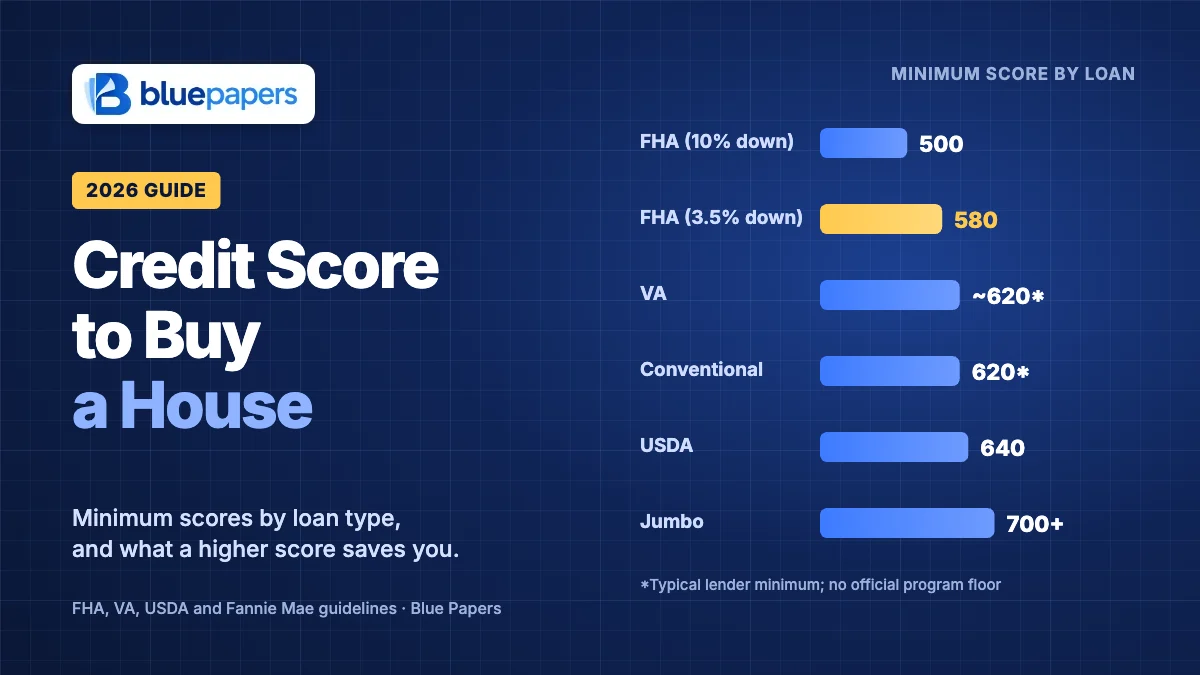
There isn’t one credit score that buys a house. The minimum credit score to buy a house is 580 for an FHA loan with 3.5% down (or 500 with 10% down), around 620 for most conventional and VA loans, and 640 for a USDA loan with automated approval. Those are floors, not targets. Borrowers with scores in the mid-700s and above usually get the best rates, and the difference can add up to tens of thousands of dollars.
The rules also changed recently. Fannie Mae dropped its hard 620 floor for loans run through its automated underwriting system, and lenders can now use VantageScore 4.0 as well as the classic FICO score. Below, we break down the credit score to buy a house for every major loan type, explain what’s new in 2026, and show how to raise your score before you apply.
Table of Contents
Minimum Credit Score to Buy a House by Loan Type
Your loan type sets the minimum credit score to buy a house, not the price of the home. Here’s how the main programs compare:
| Loan type | Minimum score | Minimum down payment | Good fit for |
|---|---|---|---|
| FHA | 580 (500–579 with 10% down) | 3.5% | First-time buyers with fair scores |
| Conventional | 620 at most lenders* | 3% | Scores in the 700s, 5%+ down |
| VA | No VA minimum; lenders usually 580–620 | 0% | Eligible veterans and service members |
| USDA | 640 for automated approval | 0% | Moderate incomes in eligible rural areas |
| Jumbo | Often 700+ | 10%–20% | Loans above the conforming limit |
FHA loans. Backed by the Federal Housing Administration, FHA loans are the most forgiving option. A score of 580 or higher qualifies for the 3.5% minimum down payment. Scores from 500 to 579 are eligible with at least 10% down, though far fewer lenders will approve them. Below 500, FHA isn’t available. The trade-off is mortgage insurance: FHA charges an upfront premium plus an annual premium that, for most borrowers with less than 10% down, lasts for the life of the loan.
Conventional loans. These follow Fannie Mae and Freddie Mac rules. For years the credit score to buy a house with a conventional loan was a firm 620. Since November 2025, Fannie Mae’s Desktop Underwriter weighs your whole profile instead of applying a hard cutoff, but most lenders still set their own 620 minimum. Conventional loans reward higher scores most: pricing improves in steps as your score rises, and private mortgage insurance gets cheaper too.
VA loans. The Department of Veterans Affairs doesn’t set a minimum credit score to buy a house with a VA loan. Lenders do, and most look for 580 to 620. VA loans need no down payment and no monthly mortgage insurance, which makes them the best deal available if you’re eligible.
USDA loans. USDA guaranteed loans also allow 0% down in eligible rural and suburban areas for buyers under the income limits. A credit score to buy a house of 640 or higher qualifies for the streamlined automated review. Lower scores may still be approved through a manual review with more documentation.
Jumbo loans. Loans above the conforming limit aren’t backed by Fannie Mae or Freddie Mac, so each lender sets its own rules. Expect the credit score to buy a house with a jumbo loan to be around 700 or higher, larger cash reserves and a bigger down payment.
What’s New in 2026: No Hard 620 Floor and New Scoring Models
Two recent changes affect the credit score to buy a house for millions of buyers:
- Fannie Mae removed its 620 minimum from Desktop Underwriter. For loan applications created on or after November 16, 2025, the system evaluates overall risk (income, assets, debts and payment history) instead of rejecting every score below 620. In practice, many lenders keep a 620 minimum as their own rule, so don’t count on approval below it.
- VantageScore 4.0 is now accepted. According to the Federal Housing Finance Agency, lenders can now choose between Classic FICO and VantageScore 4.0 for loans sold to Fannie Mae and Freddie Mac. VantageScore 4.0 can include rent and utility payments, which may help people with thin credit files.
- FHA is modernizing too. HUD has announced plans to accept newer scoring models for FHA loans. Until your lender says otherwise, assume they’re still using Classic FICO.
How Lenders Read Your Score
The score in your banking app probably isn’t the one a mortgage lender will use. Most lenders pull reports from all three bureaus (Equifax, Experian and TransUnion) and use older FICO versions built for mortgages. They then take your middle score. If your scores are 690, 704 and 721, your mortgage score is 704.
With two borrowers, lenders have traditionally used the lower of the two middle scores, although some programs now average them. Ask your lender which method applies, because it can change your rate. If one partner has much weaker credit, it may make sense for the stronger applicant to apply alone, as long as their income qualifies.
Your score is only one part of the picture. Lenders also look at your debt-to-income ratio, your down payment, your cash reserves and your job history. A strong score can’t fully offset a debt load that’s too high, and a modest score can be fine with a big down payment and low debts.
What a Higher Score Is Worth
The minimum credit score to buy a house gets you in the door. A higher score gets you a better deal. Lenders price risk, so a lower score usually means a higher rate. Here’s what that difference looks like on a $360,000 30-year mortgage:
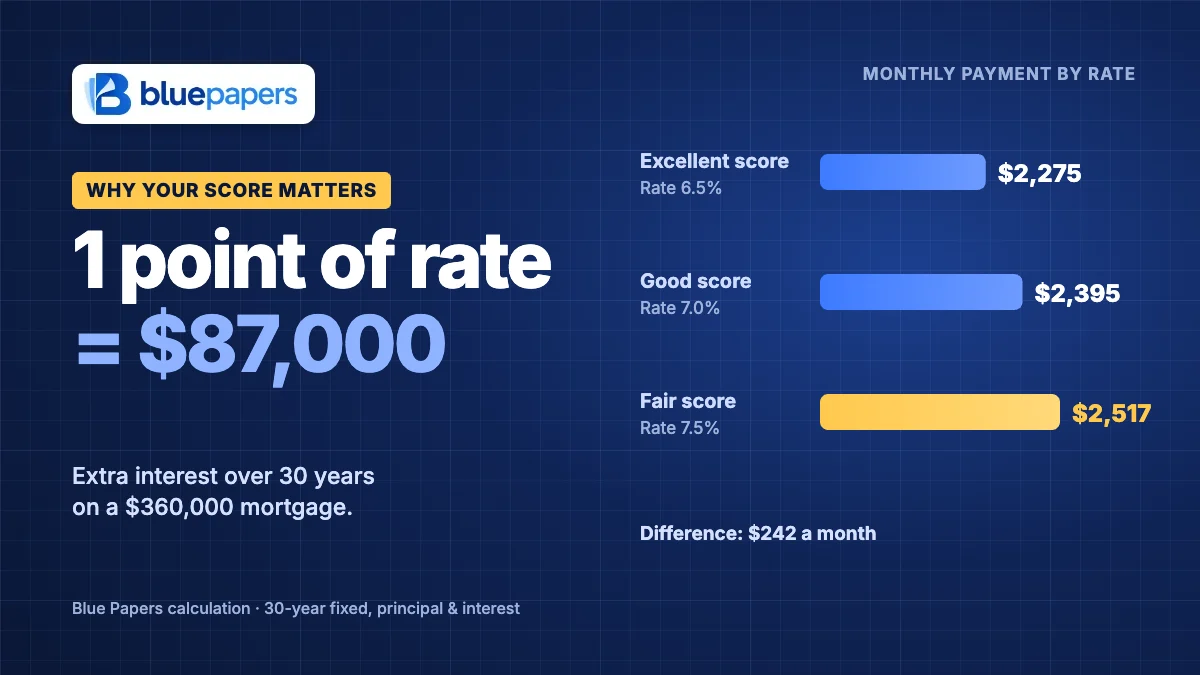
| Score profile (illustrative) | Rate | Monthly principal & interest | Interest vs. 6.5% over 30 years |
|---|---|---|---|
| Excellent | 6.5% | $2,275 | — |
| Good | 7.0% | $2,395 | +$43,000 |
| Fair | 7.5% | $2,517 | +$87,000 |
A one-point rate gap costs about $242 a month, or roughly $87,000 over the life of the loan. That’s why raising your score by even 20 or 40 points before you apply can be one of the highest-return moves you ever make. The CFPB’s Explore Interest Rates tool lets you see how rates change with your score in your state.
Try it with your own numbers. Enter your credit score, a score you could realistically reach in a few months, and your expected loan amount to see what the difference is worth — and which loan types your current score qualifies for.
Rates are illustrative: the calculator adds 0.5 percentage point for scores of 670–739, 1.0 point for 580–669 and 1.5 points below 580 to the top-tier rate you enter, matching the example table above. Real pricing also depends on down payment, loan type and lender. Principal and interest only; taxes, insurance and mortgage insurance are not included. Estimates only, not financial advice. Nothing you enter leaves your browser.
Where Does Your Score Fall? FICO Ranges Explained
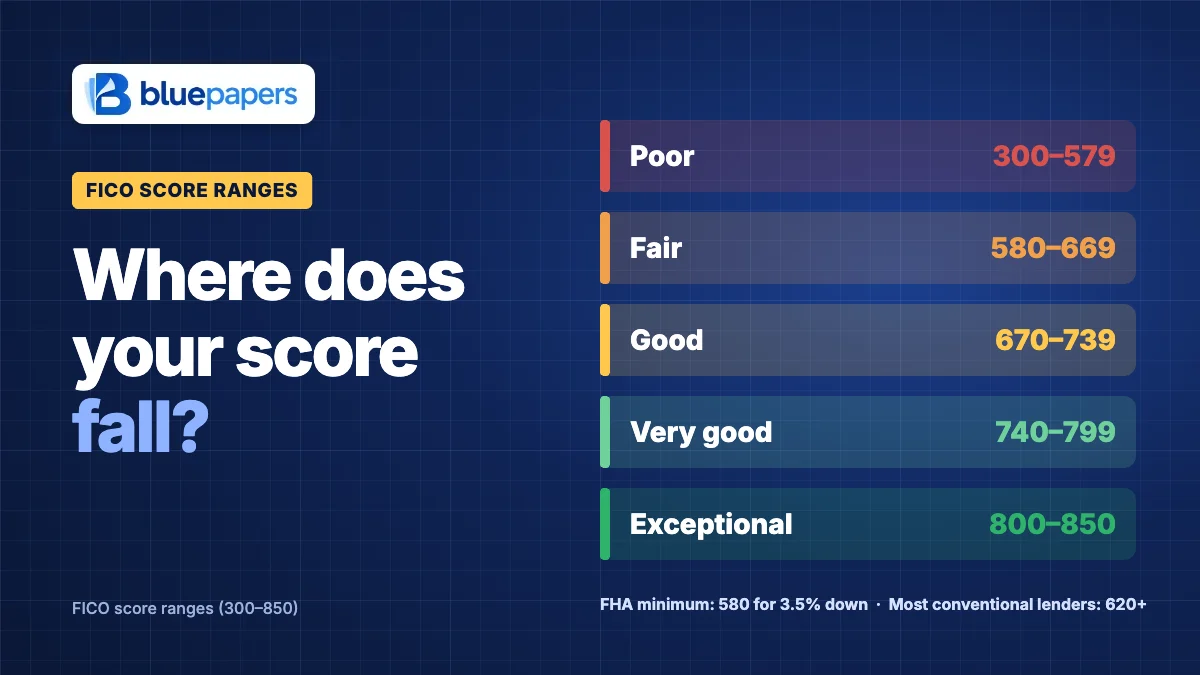
- Exceptional (800–850): the best pricing available, well above the credit score to buy a house with any loan. Beyond this point, a higher score rarely changes your rate.
- Very good (740–799): strong approval odds and near-top pricing on every loan type.
- Good (670–739): the range most people mean by a good credit score. You’ll qualify for conventional loans, but raising your score further can still lower your rate.
- Fair (580–669): FHA is usually the best path. Some conventional lenders will approve 620+, often at higher cost.
- Poor (300–579): limited options. FHA with 10% down may work at 500+, but improving your credit first usually saves money.
How to Raise Your Score Before You Apply
If you’re six months to a year from buying, you have time to move your credit score to buy a house meaningfully. Start by planning to check your credit score before buying a house, not after you’ve found one you love. Then work through these steps:
- Pull all three credit reports for free at AnnualCreditReport.com and dispute any errors. A wrong late payment or a debt that isn’t yours can cost dozens of points.
- Pay down credit card balances. Your utilization (balances divided by limits) is one of the fastest things to change. Aim for under 30% on every card, and under 10% for the best results.
- Pay every bill on time. Payment history is the largest part of your score. Set up autopay for at least the minimum on every account.
- Don’t open or close accounts in the months before you apply. New accounts add hard inquiries and lower your average account age. Closing old cards can raise your utilization.
- Time your balance payments. Card issuers usually report your balance on the statement date. Paying before that date makes your reported utilization lower.
- Ask about a rapid rescore. If you pay down debt during the mortgage process, your lender may be able to update your score in days instead of waiting for the next reporting cycle.
Prefer to watch? This short video from Experian explains what lenders look for and how to prepare.
First-Time Buyer Programs for Lower Scores
If you’re buying your first home, the credit score to buy a house can be lower than you expect, because several programs are built for exactly your situation.
State housing finance agency loans. Every state has a housing finance agency that offers first-time buyer mortgages, and many pair them with down payment assistance. The typical credit score to buy a house through these programs is 620 to 640, though some accept FHA-level scores. Assistance often comes as a grant or a forgivable second loan that covers part of your down payment or closing costs.
3%-down conventional programs. Fannie Mae HomeReady and Freddie Mac Home Possible allow just 3% down for buyers under local income limits, with mortgage insurance you can cancel later. Most lenders still look for a credit score to buy a house of about 620 for these loans, and pricing improves quickly as your score climbs into the 700s.
Homebuyer education. Many of these programs require a short online course. It’s worth doing even when it isn’t required: HUD-approved counselors can review your credit reports for free and help you plan the fastest route to a better credit score to buy a house.
The takeaway: a fair credit score to buy a house with doesn’t shut you out. It changes which door you walk through. Compare an FHA quote with a state agency quote and a 3%-down conventional quote side by side, and look at the total monthly payment, not just the rate.
Should You Buy Now or Wait?
If you already meet the minimum credit score to buy a house for your loan type, waiting isn’t automatically the right call. Compare the two sides:
- Buying now makes sense if you have stable income, a solid emergency fund and a payment you can comfortably afford. Home prices and rents may keep rising while you wait.
- Waiting makes sense if you’re a few points below an important threshold (such as 580, 620 or 740), or if paying down card debt over the next few months would raise your score quickly.
Either way, don’t use your emergency savings to make a bigger down payment. Lenders like to see cash reserves after closing, and so should you. Our emergency fund calculator shows how much to keep. To check what payment fits your budget, see How Much House Can I Afford?
Can You Streamline Refinance VA or FHA Loans Later?
Yes, and that’s one reason buying with a fair score can still work. If rates fall after you buy, both FHA and VA loans offer streamlined refinances with less paperwork and often no new appraisal. The VA’s version is called an Interest Rate Reduction Refinance Loan (IRRRL). Lenders may still set their own score requirements, but they’re often lighter than for a new purchase.
There’s a second path too. If you buy with an FHA loan and your score improves, you may be able to use a higher credit score to refinance into a conventional loan later. Once you have enough equity, that can remove FHA mortgage insurance and lower your monthly payment. Just be sure the savings outweigh the closing costs of the new loan.
Frequently Asked Questions
What credit score is needed to buy a $300,000 house?
The home’s price doesn’t set the minimum; your loan type does. You could buy a $300,000 home with a 580 score using an FHA loan or with 620+ on a conventional loan. What the price does affect is whether your income and debts qualify for the payment.
Can a 700 credit score get you a house?
Yes. A 700 credit score to buy a house is in the “good” range and meets the minimum for every major loan type, including most jumbo loans. You may get a better rate by reaching 740 or higher, but 700 is a solid place to buy from.
How much of a house can I afford if I make $70,000 a year?
About $210,000 at a 7% rate with 10% down and modest debts. See the full breakdown in How Much House Can I Afford on $70K?
How can I raise my credit score 100 points in 30 days?
Usually you can’t, and be wary of anyone who promises it. The main exceptions are fixing a major reporting error or paying high credit card balances down to near zero, which can produce a big jump within one or two billing cycles.
Should I wait to increase my credit score before I buy?
Wait if a few months of paying down debt would push you over an important threshold like 620 or 740, since that can lower your rate for 30 years. If you’re already well above your loan’s minimum, the gain from waiting is smaller.
Do mortgage lenders use FICO or VantageScore?
Most still use Classic FICO, but lenders can now use VantageScore 4.0 for conventional loans sold to Fannie Mae and Freddie Mac. Ask your lender which model and which bureaus they pull.
Will shopping for a mortgage hurt my credit score?
Only slightly. Credit scoring models count multiple mortgage inquiries within a short window (14 to 45 days, depending on the model) as a single inquiry, so compare several lenders within a few weeks.
Is the credit score to buy a house different for a condo or a second home?
Often, yes. Condos can face stricter lender rules, and second homes and investment properties usually require a higher credit score to buy a house than a primary residence, plus a larger down payment and more cash reserves. If you’re buying anything other than the home you’ll live in, ask each lender for its minimum before you apply.
The bottom line: the minimum credit score to buy a house is lower than many people think, but the minimum is rarely the smartest target. Know your middle score, pick the loan type that fits it, and give yourself a few months to raise it if you’re close to a threshold. A better credit score to buy a house with can save you more money than almost any other step in the process.
- How Much House Can I Afford on $100K?
- When Does PMI Go Away?
- Debt to Income Ratio
- How to Build Credit From Scratch
Updated September 26, 2026. Loan program rules change often and lenders can set stricter requirements. This article is for educational purposes only and is not financial or lending advice.
Sources: Fannie Mae Selling Guide update (November 2025) · Federal Housing Finance Agency, Credit Scores · HUD FHA Single Family Housing Policy Handbook 4000.1 · CFPB Explore Interest Rates · Experian (video above)
Leave a Reply