
If you have federal student loans, 2026 forced a decision. The SAVE plan is gone, the new Repayment Assistance Plan (RAP) opened on July 1, and Income-Based Repayment (IBR) is now the main alternative for existing borrowers. Most comparisons of RAP vs IBR stop at “RAP is 1% to 10% of income, IBR is 10% to 15% of discretionary income.” That’s not enough to choose.
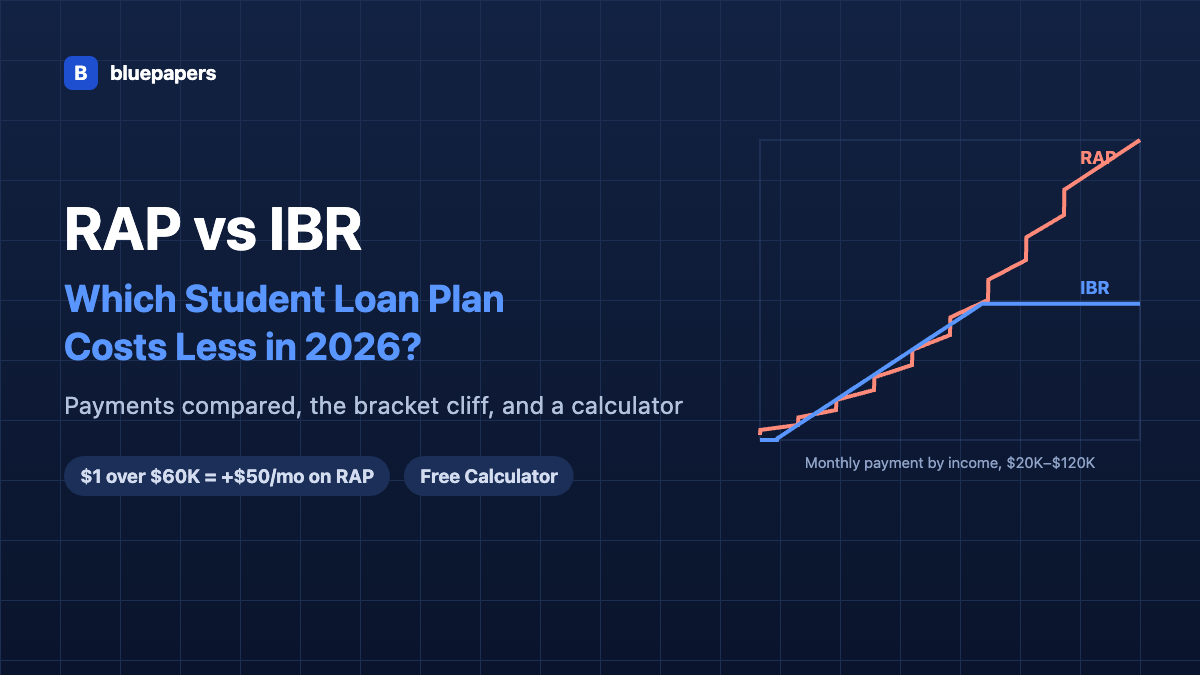
The two plans are built in opposite ways. IBR charges a percentage of the income above a poverty-line allowance and stops rising once it hits the standard 10-year payment. RAP charges a percentage of your whole income, with no allowance and no cap, and the rate jumps at every $10,000 of income. That design creates bracket cliffs where earning $1 more can raise your payment by $50 a month. Here’s how to compare the plans for your situation, with a calculator that runs both.
Table of Contents
RAP vs IBR: Who Pays Less
- RAP usually costs less for single borrowers with low to moderate income (roughly under $70,000), and its interest waiver keeps your balance from growing when your payment is small.
- IBR usually costs less for higher earners, because its payment is capped at the 10-year standard amount, and for borrowers with children, because its poverty-line allowance grows with family size much faster than RAP’s $50-per-dependent credit.
- IBR forgives sooner: after 20 years for borrowers whose first loans came on or after July 1, 2014, or 25 years for older borrowers. RAP forgives after 30 years.
- The switch is one-way for forgiveness credit. Payments made under IBR count toward RAP’s 30-year clock, but months on RAP don’t count toward IBR’s.
How Each Plan Calculates Your Payment
| RAP | IBR | |
|---|---|---|
| Payment formula | 1% to 10% of your whole AGI, depending on your $10,000 income bracket | 10% (or 15% for older borrowers) of AGI above 150% of the poverty line |
| Family adjustment | $50 off the monthly payment per dependent | Poverty-line allowance rises with family size |
| Minimum payment | $10 a month | $0 possible |
| Maximum payment | None | 10-year standard payment |
| Unpaid interest | Waived on full, on-time payments, plus up to $50 a month of principal reduction | Accrues and adds to what you owe |
| Forgiveness | After 360 qualifying payments (30 years) | After 20 or 25 years |
| Who can use it | All Direct Loan borrowers except Parent PLUS | Existing borrowers; not available for loans made on or after July 1, 2026 |
RAP’s brackets run in $10,000 steps: AGI of $10,001 to $20,000 pays 1%, $20,001 to $30,000 pays 2%, and so on up to 10% for AGI over $100,000. AGI of $10,000 or less pays the $10 minimum. For IBR, 150% of the 2026 poverty guideline is $23,940 for a single person and $32,460 for a family of two, rising by $8,520 for each additional person. Since the 2025 tax and budget law, IBR no longer requires a “partial financial hardship” to enroll, so higher earners can use it too.
RAP vs IBR Payments at Different Incomes
Here are monthly payments on a $40,000 balance at 6.5% interest. The 10-year standard payment on that balance, which caps IBR, is $454.
| AGI | Single: RAP | Single: IBR (10%) | Single: IBR (15%) | Single parent, 2 kids: RAP | Single parent, 2 kids: IBR (10%) |
|---|---|---|---|---|---|
| $30,000 | $50 | $51 | $76 | $10 | $0 |
| $45,000 | $150 | $176 | $263 | $50 | $34 |
| $60,000 | $250 | $301 | $451 | $150 | $159 |
| $75,000 | $438 | $426 | $454 | $338 | $284 |
| $100,000 | $750 | $454 | $454 | $650 | $454 |
| $120,000 | $1,000 | $454 | $454 | $900 | $454 |

For a single borrower, RAP wins up to about $70,000 of AGI, and it wins by a lot against the older 15% version of IBR. Above that, IBR’s cap takes over: at $100,000, RAP costs $296 a month more. For the single parent, IBR is cheaper at most incomes, because a family of three gets a $40,980 poverty-line allowance under IBR but only $100 a month off under RAP.
The RAP Bracket Cliff: When a $1 Raise Costs $50 a Month
RAP applies its rate to your entire AGI, not just the part above each bracket line. So crossing a line raises the payment on every dollar you earn:
| AGI | RAP rate | Monthly payment |
|---|---|---|
| $60,000 | 5% | $250 |
| $60,001 | 6% | $300 |
| $100,000 | 9% | $750 |
| $100,001 | 10% | $833 |
A $1 raise past $60,000 costs $600 a year in higher payments. Past $100,000, it costs $1,000 a year. The jump at each line equals 1% of the bracket boundary, so the cliffs get steeper as income rises.
The fix is to manage your AGI, not your salary. Pre-tax 401(k) or 403(b) contributions, HSA contributions and traditional IRA deductions all lower AGI. If you’re $1,500 over a line, putting an extra $1,500 into a pre-tax 401(k) would cut a RAP payment by about $58 a month and also lower your taxes. The calculator below flags it when you’re within $3,000 of a bracket line. IBR has no cliffs: each extra dollar of income raises the payment by 10 or 15 cents a year.
RAP vs IBR Calculator
To compare RAP vs IBR for yourself, use the AGI from your most recent tax return, since that’s what your servicer will use. Family size for IBR counts you, your spouse and the children you support. Dependents for RAP are the dependents you claim on your tax return.
RAP: your whole AGI times a rate from 1% (AGI $10,001 to $20,000) to 10% (over $100,000), divided by 12, minus $50 for each dependent, with a $10 minimum. IBR: 10% or 15% of income above 150% of the 2026 federal poverty guideline ($15,960 for one person plus $5,680 per extra person, 48 states and DC), capped at the 10-year standard payment on the balance you enter. Married borrowers who file jointly use combined income under both plans. Estimates only; your servicer’s calculation is final. Nothing you enter leaves your browser.
Interest and Forgiveness: The Long-Run Trade-Off
A lower payment isn’t the whole RAP vs IBR story. On a $40,000 balance at 6.5%, interest runs about $217 a month. A single borrower earning $45,000 pays $150 on RAP. The $67 of interest that payment doesn’t cover is waived, and because none of the payment reaches principal, the government adds a $50 principal reduction. The balance shrinks by $50 a month even with a small payment. On IBR, the same borrower pays $176, and the $41 of unpaid interest keeps accruing, about $490 a year.
Forgiveness pulls the other way. IBR forgives what’s left after 20 years for most borrowers who took their first loans after mid-2014, while RAP takes 30. If you expect to stay on an income-driven plan until forgiveness, ten extra years of payments can outweigh a few years of interest waivers. One more rule matters for anyone switching: payments made under IBR count toward RAP’s 360-payment requirement, but RAP months don’t count toward IBR forgiveness. Moving from IBR to RAP keeps your progress. Moving from RAP back to IBR picks up the IBR clock where you left it, with no credit for the RAP years.
If you’re pursuing Public Service Loan Forgiveness, both plans count toward the 120 qualifying payments. In that case, the plan with the lower payment is usually the better one, since the balance is forgiven after 10 years anyway.
What Changed in 2026, and Your Deadlines
- SAVE is over. On March 27, 2026, the Department of Education told the 7.5 million borrowers in SAVE to move to another plan. Each borrower gets 90 days from their servicer’s notice to choose. Borrowers who don’t choose are placed in the Standard or the new Tiered Standard plan, which aren’t income-driven.
- RAP launched July 1, 2026. New loans made on or after that date can only use RAP or the Tiered Standard plan.
- PAYE and ICR are closing. Borrowers in those plans must move to IBR or RAP by July 1, 2028.
- Parent PLUS loans can’t use RAP. Parent PLUS loans consolidated before July 1, 2026 can use IBR.
If you got a notice and haven’t picked a plan, run your RAP vs IBR numbers in the calculator, then apply on StudentAid.gov or through your servicer before the 90 days run out. Landing in a standard plan by default can mean a much higher bill. If student loans are only one of your debts, our guide to the debt avalanche vs. snowball helps you decide where extra money should go, and your debt-to-income ratio shows how the payment affects a future mortgage.
No Bracket Cliff in Australia or Korea
Australia just removed exactly this kind of cliff. There, student debt (HELP, still often called HECS) is repaid through the tax system. The old system charged a percentage of your entire income once you passed a threshold, so a small raise could cost more than it paid. From the 2025–26 income year, repayments apply only to income above the threshold: 15 cents for each dollar over $67,000, with the threshold rising to $69,528 for 2026–27. The same reform cut existing HELP balances by 20%. HELP debt also carries no real interest; it’s indexed to inflation or wage growth, whichever is lower.
Korea uses the same marginal idea. Its income-contingent student loans (취업 후 상환 학자금대출) are collected by the National Tax Service at 20% of income above a repayment threshold for undergraduate loans, and 25% for graduate loans. In both countries, earning a dollar more never costs you more than a fraction of that dollar. RAP’s whole-income brackets are the outlier, which is why your AGI matters so much under it.
RAP vs IBR: How to Choose in 4 Steps
- Compare this year’s payments in the calculator with your real AGI, family size and balance.
- Check the bracket line. If you’re just over one, pre-tax retirement or HSA contributions may make RAP cheaper.
- Think about the next five years. If your income is likely to rise past $75,000 to $100,000, IBR’s cap protects you and RAP’s doesn’t.
- Decide whether you’ll pay off or reach forgiveness. If you’ll pay the loans off, RAP’s interest waiver helps. If you’ll reach forgiveness, IBR’s 20- or 25-year timeline usually wins.
Frequently Asked Questions
RAP vs IBR: which is better?
It depends on your income, family size and goal. RAP vs IBR comes down to this: RAP is usually cheaper for single borrowers earning under about $70,000 and waives unpaid interest, while IBR is usually cheaper for higher earners and families because its payment is capped and its poverty-line allowance grows with family size. IBR also forgives the remaining balance after 20 or 25 years, compared with 30 years on RAP.
How is the RAP payment calculated?
Take your adjusted gross income, multiply it by your bracket rate (1% for AGI of $10,001 to $20,000, rising by 1 point every $10,000 up to 10% above $100,000), divide by 12 and subtract $50 for each dependent. The minimum payment is $10 a month. The rate applies to your whole AGI, not just the income above each bracket line.
Can I switch from RAP back to IBR?
Existing borrowers can generally move between the plans, but forgiveness credit only flows one way. Payments made under IBR count toward RAP’s 360-payment requirement, while months on RAP don’t count toward IBR’s 20- or 25-year forgiveness. New loans made on or after July 1, 2026 can’t use IBR at all.
What happens if I was on SAVE and don’t pick a new plan?
The Department of Education gives SAVE borrowers 90 days from their servicer’s notice to choose. If you don’t, you’re placed in the Standard or Tiered Standard plan, which isn’t based on income and can mean a much higher payment. You can still apply for RAP or IBR afterward.
Does RAP count for Public Service Loan Forgiveness?
Yes. Full, on-time payments under RAP count toward the 120 qualifying payments for PSLF, and so do payments under IBR. If you’re on track for PSLF, the plan with the lower monthly payment usually makes the most sense.
RAP vs IBR isn’t a question with one right answer. RAP is the better deal for single, moderate-income borrowers who want their balance to stop growing. IBR is the better deal for families, higher earners and anyone aiming for forgiveness. Run your numbers, check whether you’re near a bracket line, and make the choice before your servicer makes it for you.
If you are still deciding
- Credit Card Minimum Payment Calculator
- How to Build Credit From Scratch
- How Much Should I Save for Retirement?
- 50/30/20 Rule
Updated October 7, 2026. Written by Jun, who is not a licensed financial advisor. Examples assume a $40,000 Direct Loan balance at 6.5% and 2026 poverty guidelines for the 48 contiguous states and DC; IBR’s cap is based on the balance when you enter the plan. Your servicer’s calculation is final. Calculator results are estimates for planning only.
Sources: U.S. Department of Education, SAVE transition announcement (March 27, 2026) and One Big Beautiful Bill Act guidance · Federal Student Aid, Repayment Assistance Plan · HHS, 2026 poverty guidelines · Student Loan Planner, RAP rules · Australian Taxation Office, HELP repayment thresholds · Korea National Tax Service, income-contingent student loan repayment
Leave a Reply