
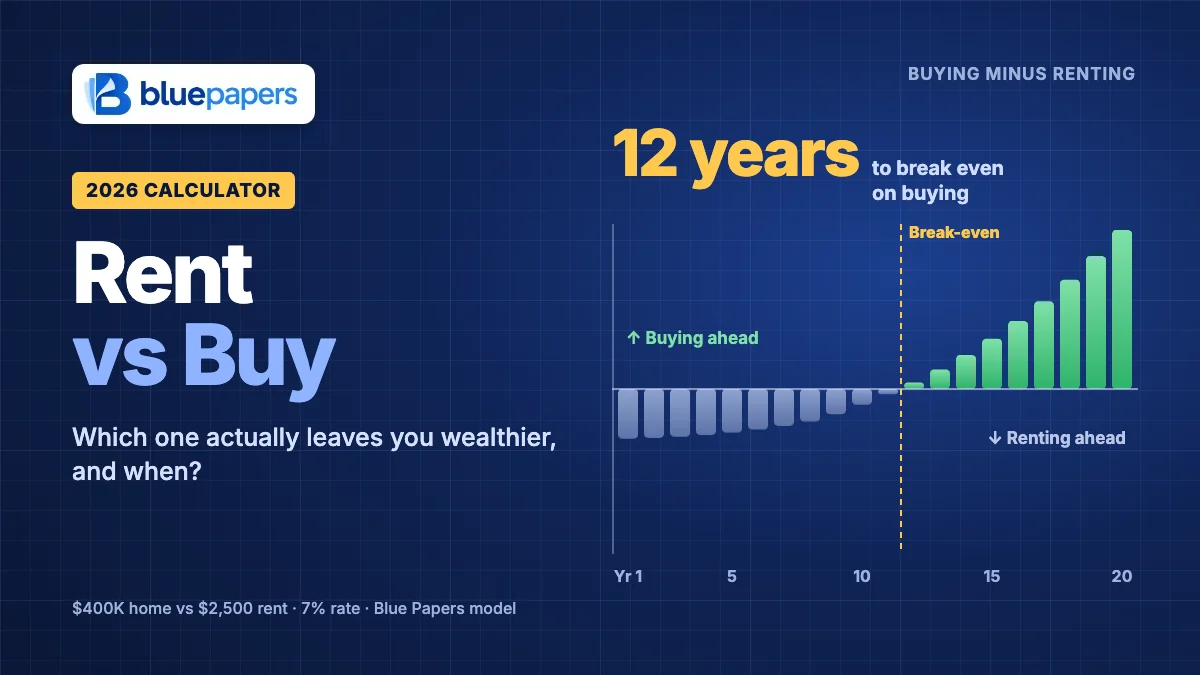
Rent or buy? The answer depends mostly on how long you’ll stay. At today’s mortgage rates of about 7%, buying a $400,000 home instead of renting a similar home for $2,500 a month takes about 12 years to break even. Move sooner, and renting while investing the difference leaves you wealthier. Stay longer, and buying pulls ahead, with the gap growing every year.
Your own break-even point could be 7 years or 25, depending on local rents, home prices and your mortgage rate. That’s why a generic rule of thumb isn’t enough. Use the free rent vs buy calculator below with your real numbers, then read on to see what drives the result.
Table of Contents
Free Rent vs Buy Calculator
Enter the home price, a realistic rent for a similar home, and how many years you expect to stay. Open the advanced settings to change home price growth, rent increases, investment returns and ownership costs.
Rent vs Buy Calculator
Which leaves you wealthier, and after how many years?
Adjust growth, returns and ownership costs
Buying minus renting, by year
How it works: the buyer’s wealth is the home’s sale value minus selling costs and the remaining loan, plus any savings they invest. The renter invests the down payment and closing costs instead, and whoever has the lower monthly cost invests the difference. PMI is estimated at 0.6% of the loan until you reach 20% equity. Taxes on gains and mortgage interest deductions are not included. Estimates only, not financial advice.
Why Use a Rent vs Buy Calculator?
Most people make the biggest financial decision of their lives with a gut feeling. Rent vs buy questions are too big for that. A rent or buy calculator turns vague worries into one clear number: the year when owning starts to beat renting for your situation.
That number is subject to change, of course. Rates move, rents rise and plans shift. The value of a calculator: rent vs buy scenarios can be tested in seconds, so you can see how sensitive your decision is before you sign a lease or a 30-year mortgage.
How to Use This Rent vs Buy Calculator
- Enter the home price. Use the price of a home you would realistically buy, not your maximum pre-approval.
- Enter the rent for a similar home. Compare like with like: same neighborhood, size and quality. This is the single most important input.
- Enter how long you’ll stay. Be honest. Job changes, growing families and relocations are the most common reasons people sell early.
- Add your mortgage rate and down payment. Use a real quote from a lender if you have one.
- Check the break-even year. If you plan to stay longer than that, buying likely wins. If not, renting likely wins.
- Stress-test the result. Lower the home price growth to 2% and raise the investment return to 7%. If buying still wins, it’s a robust decision.
Why “Rent Is Throwing Money Away” Is Wrong
Rent buys you a place to live. So does a mortgage, but a mortgage payment is only part of what an owner spends. Owners also pay costs they never get back, and a fair rent vs buy comparison has to count all of them:
- Mortgage interest: in the early years, most of each payment is interest, not equity
- Property tax and homeowners insurance
- Maintenance: about 1% of the home’s value per year
- PMI, if you put down less than 20%
- Closing costs: about 3% when you buy
- Selling costs: about 6% when you sell
A good rent vs buy calculator sets all of those against rent. It also asks what the renter could earn by investing the down payment and closing costs instead. That opportunity cost is the piece most people forget, and it’s exactly what our calculator includes.
Rent vs Buy Example: $400,000 Home vs $2,500 Rent
Assumptions: a 30-year fixed mortgage at 7%, 10% down, home prices and rents both rising 3% a year, and a 6% annual return on invested savings. Property tax is 1.1%, insurance 0.5% and maintenance 1% of the home’s value per year.
Month 1 cost of owning: $3,442
| Cost | Per month |
|---|---|
| Principal & interest | $2,395 |
| Property tax (1.1%) | $367 |
| Maintenance (1%) | $333 |
| PMI | $180 |
| Homeowners insurance (0.5%) | $167 |
| Total | $3,442 |
That’s $942 more than rent every month, and buying takes $52,000 in cash upfront for the down payment and closing costs. In the calculator, the renter invests both the $52,000 and the $942 monthly difference.
Who comes out ahead, and by how much
| You stay | Wealthier option | Difference |
|---|---|---|
| 1 year | Renting | $35,792 |
| 5 years | Renting | $31,410 |
| 7 years | Renting | $26,602 |
| 10 years | Renting | $11,408 |
| 12 years | Break-even | — |
| 15 years | Buying | $36,225 |
| 20 years | Buying | $114,644 |
| 30 years | Buying | $423,804 |
The first year is the worst for buyers. You pay about 3% to buy and would pay another 6% to sell, while very little of your payment has gone toward principal. After that, three forces work in your favor: your loan balance shrinks, the home’s value grows on the full $400,000 price, and rent keeps rising while your principal and interest payment stays fixed. You can watch this happen year by year in the chart inside the rent vs buy calculator above.
What Changes Your Rent vs Buy Break-Even Point
Starting from the example above, here’s how the break-even year moves when you change one input at a time:
| If this changes… | Break-even year |
|---|---|
| Base case | Year 12 |
| Mortgage rate drops to 6% | Year 7 |
| Mortgage rate rises to 8% | Year 22 |
| Rent is $2,800 instead of $2,500 | Year 7 |
| Rent is $2,200 instead of $2,500 | Year 29 |
| Home prices grow 4% a year | Year 7 |
| Home prices grow 2% a year | Year 18 |
| Rents rise 4% a year | Year 10 |
| Rents rise 2% a year | Year 20 |
| You put 20% down (no PMI) | Year 8 |
| Investments return 8% a year | Renting stays ahead for 30 years |
Three takeaways from the rent vs buy calculator:
- Rent compared with price matters most. A $300 difference in monthly rent moves the break-even point by more than a decade.
- Mortgage rates matter a lot. A one-point change in the rate moves the break-even point by 5 to 10 years.
- Buying is a long-term decision. If you expect to move within 7 years, renting usually wins at today’s rates.
Quick Rules of Thumb Before You Use a Rent vs Buy Calculator
Rules of thumb are useful for a first check in 30 seconds. They are not a substitute for running your own numbers, especially when mortgage rates are high. Use them to sanity-check what the rent vs buy calculator tells you.
1. The price-to-rent ratio
Price-to-rent ratio = home price ÷ annual rent. For our example, $400,000 ÷ ($2,500 × 12) = 13.3.
The traditional rule said a ratio under 15 favors buying and over 20 favors renting. That rule dates from a time of lower mortgage rates. In our model at 7%, a ratio of 13.3 breaks even in 12 years, while a ratio of 15.2 (the same home at $2,200 rent) takes 29 years. At today’s rates, treat a ratio above about 14 as a warning sign.
2. The 5% rule
Popularized by financial planner Ben Felix, the 5% rule estimates the yearly costs of owning that you never get back: about 1% property tax, 1% maintenance and 3% cost of capital. Multiply the home price by 5% and divide by 12. If you can rent a similar home for less than that, renting is likely the better financial choice.
For a $400,000 home, 5% is $20,000 a year, or about $1,667 a month. The catch: the 3% cost of capital assumes low mortgage rates. With a 7% mortgage, our estimate of the unrecoverable cost is closer to 6.5%, or about $2,167 a month for the same home. That lines up with the calculator: at $2,200 rent, buying takes nearly 30 years to win.
3. The 50/30/20 and 30% rent rules
The 50/30/20 budget puts housing inside the 50% of take-home pay reserved for needs. A separate, older guideline says rent should be no more than 30% of gross income. Neither tells you whether to rent or buy. They only tell you whether a housing payment fits your budget. To see what price fits, use our How Much House Can I Afford? calculator.
When Buying Makes More Sense
- You expect to stay 10 years or more
- Local rents are high compared with home prices (a price-to-rent ratio under about 13)
- You can put 20% down, so you avoid PMI
- You want stability: no rent increases and no landlord deciding when you move
- You’ll put money into your home that you wouldn’t otherwise save or invest
The last point matters. Any rent vs buy calculator assumes the renter actually invests the difference every month. In real life, many renters don’t. A mortgage works like forced savings, which is one reason homeowners tend to have much higher net worth. See our Net Worth by Age guide for the numbers.
When Renting Makes More Sense
- You may move for work within 5 to 7 years
- Homes in your area are expensive compared with rents
- Buying would use up your emergency fund (see our Average Savings by Age guide for a healthy cushion)
- Your income is unstable or you’re changing careers
- You’re disciplined enough to invest the difference automatically
Hidden Costs Most Rent or Buy Comparisons Miss
Hidden costs of owning
- Big repairs: a roof, HVAC system or water heater can cost thousands in a single year
- HOA dues and special assessments in condos and planned communities
- Rising property taxes and insurance premiums after you buy
- Furnishing and upkeep: more space usually means more to fill and maintain
- Time: maintenance, contractors and paperwork
Hidden costs of renting
- Rent increases at every renewal, often faster than inflation
- Moving costs when a landlord sells or won’t renew
- Renter’s insurance, application fees and security deposits
- No control over renovations, pets or how long you can stay
What This Rent vs Buy Calculator Doesn’t Include
Every calculator simplifies. Here’s what ours leaves out, so you can adjust for it:
- Tax effects: most homeowners take the standard deduction, so mortgage interest often doesn’t lower their taxes. Home sale gains of up to $250,000 ($500,000 for married couples filing jointly) are generally tax-free if you meet the ownership and use tests. See IRS Topic 701 for the details. Investment gains may be taxed.
- Renter’s insurance and HOA dues: add them yourself if they apply.
- Refinancing: if rates fall, owners can refinance, which shortens the break-even point.
- Non-financial value: stability, space, schools and the freedom to renovate.
Your Rent or Buy Decision Checklist
- Run the rent vs buy calculator with your real rent, price and rate.
- Note your break-even year and compare it with how long you’ll realistically stay.
- Stress-test: 2% home price growth, 7% investment return, one more point on the rate.
- Check affordability separately. On a $70,000 salary, for example, see our How Much House Can I Afford on $70K? guide
- Make sure you’ll still have 3 to 6 months of expenses saved after closing.
- If you rent, automate investing the monthly difference so the math actually works for you.
Rent vs Buy Calculator FAQ
Is it financially better to rent or buy?
It depends on how long you stay and how local rents compare with home prices. At 7% mortgage rates, renting is often cheaper for the first 7 to 15 years, while buying usually wins over longer periods. A rent vs buy calculator with your local numbers is the only reliable way to know.
What is the 5% rule for renting vs. buying?
The 5% rule estimates the unrecoverable yearly cost of owning at about 5% of the home price: roughly 1% property tax, 1% maintenance and 3% cost of capital. If annual rent for a similar home is below that amount, renting is likely the better financial choice. With 7% mortgage rates, the figure is closer to 6.5% in our model.
What is the 50/30/20 rule for rent?
The 50/30/20 rule splits take-home pay into 50% for needs, including rent or a mortgage, 30% for wants and 20% for savings and debt payoff. It helps you check whether housing fits your budget, but it does not tell you whether renting or buying is cheaper.
What does Dave Ramsey say about renting vs. buying?
Dave Ramsey generally advises buying only when you are debt-free, have a full emergency fund of 3 to 6 months of expenses, can put at least 10% down (ideally 20%), and can afford a 15-year fixed mortgage with a payment no higher than 25% of take-home pay. Until then, he recommends renting.
How long do you need to live in a house to make buying worth it?
The old rule of thumb was 5 years. At today’s mortgage rates, our rent vs buy calculator often shows 7 to 15 years, depending on local rents, home prices and your down payment.
Should I wait for lower mortgage rates before buying?
Lower rates shorten the break-even point significantly, but home prices can rise while you wait and no one can predict rates. If you buy now and rates fall, you may be able to refinance. Just avoid buying a home whose payment only works if you refinance later.
What investment return should I use in a rent vs buy calculator?
We use 6% a year as a moderate long-term return assumption for a diversified portfolio. Use a lower number if you would keep the money in a savings account, or a higher one if you invest mostly in stocks and will leave the money invested.
The Bottom Line
Renting isn’t throwing money away, and buying isn’t always the smart move. The right answer depends on your timeline, your local rent-to-price ratio and today’s mortgage rates. Run the rent vs buy calculator above with your own numbers, stress-test the result, and let your break-even year guide the decision.
Related guides
- How Much Rent Can I Afford?
- How Much House Can I Afford on $100K?
- When Does PMI Go Away?
- Debt to Income Ratio
Model built by Blue Papers. Mortgage rate based on Freddie Mac’s 30-year fixed average of 6.95% for the week of September 17, 2026. This article is for educational purposes only and is not financial advice.
Sources: Freddie Mac Primary Mortgage Market Survey · IRS Topic 701: Sale of Your Home · Ben Felix, Renting vs. Buying a Home: The 5% Rule (video above)
Leave a Reply