
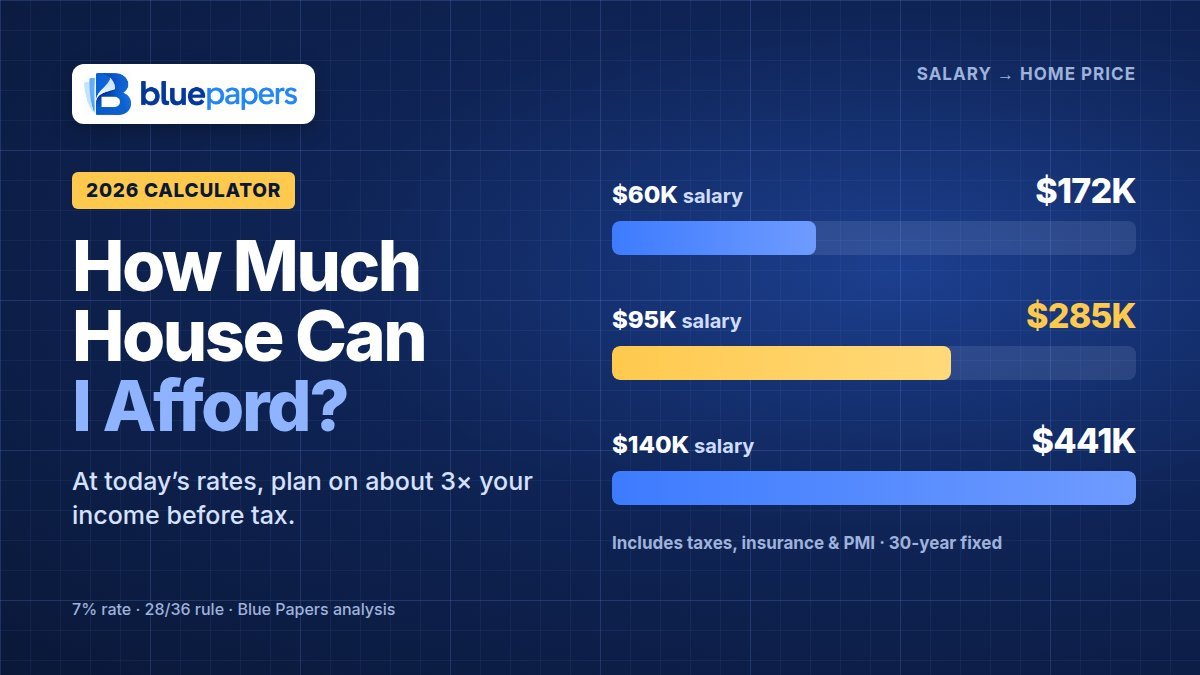
How much house can I afford? Most people can comfortably afford a home priced at about 2.5 to 3 times their gross annual income. That assumes mortgage rates around 7%, a modest amount of other debt, and total housing costs under 28% of monthly income. On a $95,000 salary, that works out to roughly $285,000.
Your own number could be higher or lower, depending on your debts, your down payment and where you live. To answer “how much house can I afford?”, enter your own figures in the calculator below and compare the results with the worked examples.
Enter your numbers. Results update as you type.
Adjust taxes, insurance, HOA and loan term
Comfortable = housing costs at 25% of gross income. Standard = the 28/36 rule (housing ≤ 28% of gross income, all debts ≤ 36%). Stretch = total debts at 43% of gross income, near the top of what many lenders approve. PMI estimated at 0.6% of the loan per year. Estimates only, not a loan offer. Your lender’s quote, credit score and local taxes will change the result.
Table of Contents
How much house can I afford? Using the calculator
Start with your annual income, available down payment and recurring monthly debt payments. Keep a record of the assumptions you enter so you can compare one scenario with another. The question “how much house can I afford?” is easier to explore when each result uses the same definitions.
Change one input at a time: try a different down payment, then a different interest rate. Compare the monthly payment as well as the purchase price. The examples below show the assumptions alongside the results, so you can see how each scenario was constructed. Save your inputs with the date; a calculation is a snapshot, not a loan approval.
How much house can I afford? Three budget levels
A lender will tell you the largest loan they’ll approve. That isn’t the same as what you can live with. So the calculator gives you three prices:
- Comfortable (25% of gross income): Housing costs leave room to save, travel, and handle a surprise repair without stress.
- Standard (the 28/36 rule): The traditional guideline lenders use. It’s a sound target for most buyers.
- Stretch (43% total debt): Close to the most many lenders will approve. You can buy here, but your budget will be tight for years.
The Blue Papers rule: Shop at the Standard number. Get pre-approved at the Stretch number so you have negotiating room. Don’t spend it. A pre-approval shows how much house you can afford on paper, not how much you should spend.
What is the 28/36 rule?
The 28/36 rule is two limits that apply together:
- 28%: Your total housing payment (mortgage, property tax, insurance, PMI, HOA) should be no more than 28% of your gross monthly income.
- 36%: All of your monthly debt payments, housing included, should be no more than 36% of gross monthly income. That covers car loans, student loans and minimum card payments.
Whichever limit is lower sets your budget. That’s why a $500 car payment can lower your home budget by tens of thousands of dollars.
How much house can I afford with my salary? 3 examples at 7%
These assume a 30-year fixed mortgage at 7%, property tax of 1.1% per year, insurance of 0.5% per year, and PMI when the down payment is under 20%.
Maya: $60,000 salary, 5% down
- Monthly gross income: $5,000
- Other debts: $300/month (car)
- Affordable price: about $172,000
- Monthly housing payment: $1,400 ($1,089 principal and interest, $158 tax, $72 insurance, $82 PMI)
- Cash needed: $8,600 down payment plus about $5,200 in closing costs
Jordan: $95,000 salary, 10% down
- Monthly gross income: $7,917
- Other debts: $500/month
- Affordable price: about $285,000
- Monthly housing payment: $2,217
- Cash needed: $28,500 down payment plus about $8,600 in closing costs
Priya: $140,000 household income, 15% down
- Monthly gross income: $11,667
- Other debts: $900/month (student loans and car)
- Affordable price: about $441,000
- Monthly housing payment: $3,267
- Cash needed: $66,100 down payment plus about $13,200 in closing costs
Notice the pattern: In all three cases the affordable price lands near 3× income. The old “5× your salary” advice comes from the years when rates were 3%. It doesn’t work in 2026. So if you’re asking how much house can I afford at today’s rates, 3× your income is a sensible starting point.
Why your interest rate changes everything
The average 30-year fixed rate was 6.95% in the week of September 17, 2026, a 19-month high, according to Freddie Mac. That average is for borrowers with excellent credit who put 20% down, so your own quote may be higher.
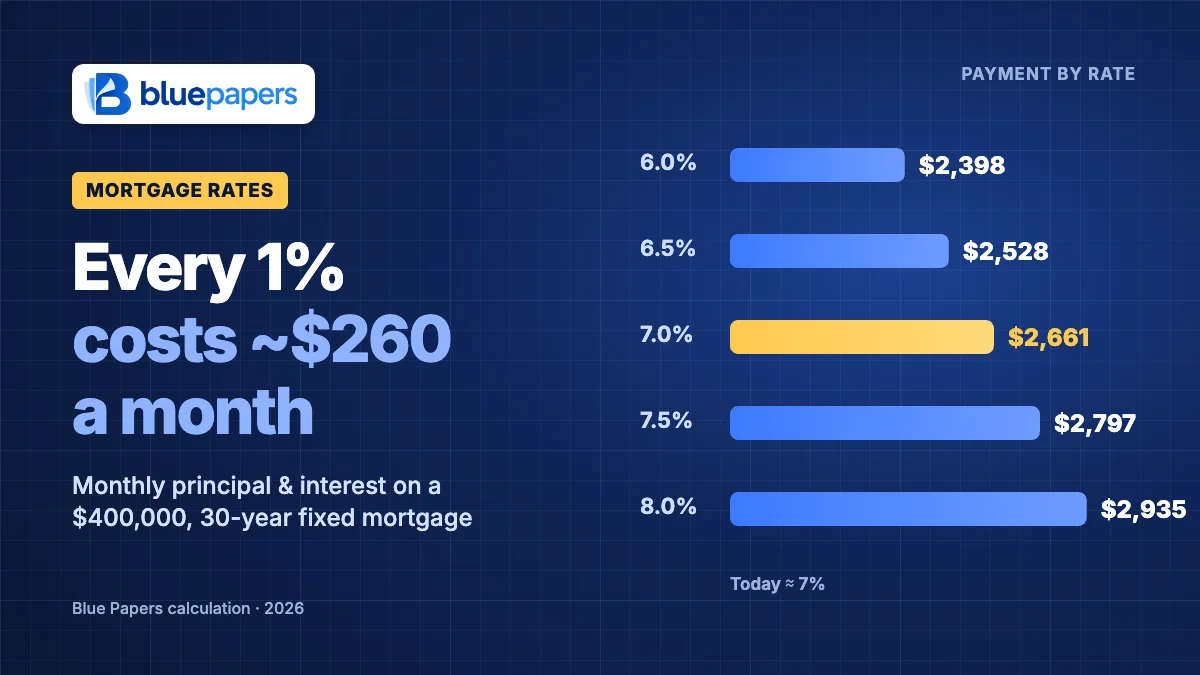
Here is the principal-and-interest payment on a $400,000 loan at different rates:
| Rate | Monthly payment | Difference vs 6% |
|---|---|---|
| 6.0% | $2,398 | — |
| 6.5% | $2,528 | +$130 |
| 7.0% | $2,661 | +$263 |
| 7.5% | $2,797 | +$399 |
| 8.0% | $2,935 | +$537 |
Each percentage point adds about $260 a month, or roughly $94,000 over 30 years. That’s why getting quotes from three lenders is the easiest money you’ll ever make on a house.
Do you really need 20% down?
No. According to the National Association of Realtors, the median first-time buyer put down 10%. Many buy with even less:
- Conventional loans: as little as 3% down
- FHA loans: 3.5% down, with more flexible credit requirements
- VA and USDA loans: 0% down for eligible buyers
The trade-off is PMI (private mortgage insurance). It usually costs 0.3% to 1.5% of the loan per year and stays until you reach 20% equity. On a conventional loan you can ask to have it removed once you get there.
Our take: Don’t wait years just to reach 20%. And don’t empty your emergency fund to get there either. The best position is a down payment you can afford plus 3 to 6 months of expenses left over after closing. Not sure how big your cushion is? Compare it with average savings by age.
The costs most calculators leave out
Your mortgage payment isn’t the full cost of owning a home. Budget for these too:
- Closing costs: usually 2% to 5% of the purchase price, due at signing
- Maintenance: plan on 1% to 2% of the home’s value per year (about $3,000 to $6,000 on a $300,000 home)
- Utilities: often higher than in an apartment
- Rising property taxes and insurance: both tend to go up after you buy
How much house can I afford with a VA loan?
If you’re an eligible veteran, service member or surviving spouse, a VA loan can stretch your budget further than any other option. According to the VA, nearly 90% of VA-backed loans are made with no down payment, and VA loans don’t charge PMI. Instead, most borrowers pay a one-time VA funding fee, which can be rolled into the loan.
VA lenders still check your debt-to-income ratio, with 41% as a common benchmark, and they also look at residual income: the money left each month after your major expenses. Because there’s no PMI, more of your monthly budget goes toward the loan itself. Check your eligibility and request a Certificate of Eligibility through the VA home loan program.
Your 5-step home-buying blueprint
- Run the calculator above and write down your Standard number.
- Check your credit score. A higher score means a lower rate.
- Pay down small debts. Every $100 of monthly debt you clear adds roughly $14,000 to your budget at 7%.
- Get quotes from three lenders on the same day so you can compare them fairly.
- Shop below your pre-approval. Your pre-approval amount is a ceiling, not a target.
Frequently asked questions
How much house can I afford on $70,000 a year?
With modest debts and 10% down at 7%, about $200,000 to $215,000. See the full breakdown in How Much House Can I Afford on $70K?.
Is 3× income too much for a house?
At today’s rates, 3× is near the upper end of comfortable for most people. If you have no other debt and a large down payment, 3.5× can work. Run the calculator above to see how much house can I afford with your own debts and down payment.
Does the calculator use gross or take-home pay?
Gross income (before tax), because that’s what lenders use. If you want a stricter test, keep your housing payment under 35% of your take-home pay.
Should I rent or buy right now?
It depends on how long you’ll stay. If it’s less than about five years, renting often wins. Find your break-even year with our Rent vs Buy Calculator.
How much house can I afford in Georgia or South Carolina?
Often more than the national examples above. Both states have below-average effective property tax rates, and home prices in many areas are lower than on the coasts, so the same salary usually stretches further. Enter your county’s tax rate in the calculator’s advanced settings, and compare rates with the Tax Foundation’s property taxes by state.
Numbers updated September 24, 2026. This article is for educational purposes only and isn’t financial advice. Speak with a licensed lender about your situation.
Sources: Freddie Mac Primary Mortgage Market Survey · NAR 2025 Profile of Home Buyers and Sellers (via Bankrate)
Related guides
- How Much House Can I Afford on $100K?
- When Does PMI Go Away?
- Credit Score to Buy a House
- Debt to Income Ratio
- How Much Rent Can I Afford?
Related reading: Put your home-buying budget in context with Net Worth by Age: Where Do You Stand in 2026?.
Leave a Reply