
When my daughter started college in the United States, I assumed the hard parts would be tuition, housing and homesickness. I didn’t expect a single number to matter so much. In the US, your three-digit score shows up when you rent an apartment, set up a phone plan, get car insurance and, years later, buy a home. And a credit history does not travel with you. Years of paying bills on time in Korea or Australia count for nothing here. Everyone has to build credit from zero.
So I read the scoring rules and the research, and this is the plan I wish we’d had on day one. It shows how to build credit from nothing in about 12 months: what to open, what to ignore, and which small habits build credit fastest. It’s written for anyone with a blank file, whether you’re 18, a new graduate or just arrived in the country.
What’s in This Guide
Why Starting From Zero Is Different From Having Bad Credit
A lender who sees a low score knows something went wrong. A lender who sees no score knows nothing at all, and to a lender “nothing” is its own kind of risk. That’s why people with a thin file often get turned down for the same starter cards that people with average credit get easily.
You’re in larger company than you might think. The Consumer Financial Protection Bureau estimates that about 2.7% of US adults had no credit record at all in 2020, and millions more had a file too thin or too old to score (CFPB, 2025 update). Young adults and recent immigrants make up a large share of both groups.
The good news: an empty file is easier to fix than a damaged one. You don’t have to outlive any late payments or collections. You only need to give the scoring models something to read, then keep it clean. Learning how to build credit from zero is mostly about patience and a few boring rules.
When Will You Get a Credit Score?
This is the question I get most, and the answer depends on which score you mean.
- FICO, the score most lenders use, needs at least one account that is six months old and has been reported in the last six months. Until then, you’re “unscorable” no matter how perfect your record is.
- VantageScore, the model behind many free score apps, can often produce a number after about one month of reporting. Don’t be surprised if an app shows you a score long before a lender can pull a FICO score.
So the real clock starts the day your first account opens. If you open it this month, you can expect a first FICO score around six months from now. Nothing you do will speed that part up, which is why the smartest move is to start building credit early, even before you think you need credit.
Here’s what goes into that score once it exists, according to myFICO:
| Factor | Weight | What it means for a new file |
|---|---|---|
| Payment history | 35% | Every on-time payment counts. One 30-day late hurts a thin file badly. |
| Amounts owed | 30% | Mostly your card utilization: balance divided by limit. |
| Length of history | 15% | You can’t rush this. Keep your first account open. |
| New credit | 10% | Several applications in a short time look risky. |
| Credit mix | 10% | Cards plus an installment loan helps, but only a little. |
Notice that the two biggest pieces, paying on time and keeping balances low, are things you control from the first month. That’s the whole secret of how to build credit fast without tricks.
How to Build Credit From Scratch: The 12-Month Plan
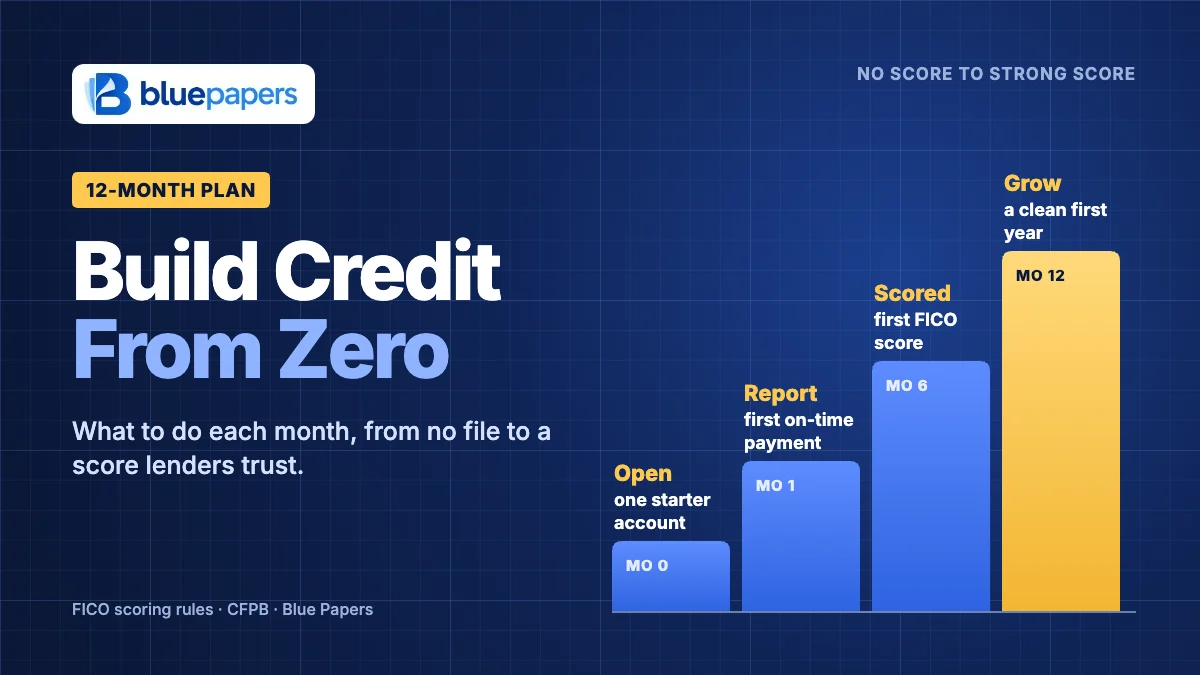
Think of the first year in four stretches. Each one has a single job.
| When | Your one job | What to do |
|---|---|---|
| Month 0 | Get on the map | Check your reports, open one starter account, turn on autopay. |
| Months 1–5 | Create a clean pattern | Use the account lightly, pay on time, keep the reported balance under 10% of the limit. |
| Month 6 | Collect your first FICO score | Check your score and all three reports. Fix any errors. |
| Months 7–12 | Strengthen the file | Ask about upgrading a secured card, maybe add a second account, keep everything else the same. |
Month 0: get on the map. Pull your free reports from all three bureaus at AnnualCreditReport.com, the only site authorized by federal law for this. You can check them free every week. If you truly have no file, the bureaus will say they can’t find you, which is useful to confirm. Then open exactly one account to build credit with (the next section helps you choose) and set up autopay for at least the minimum payment on day one.
Months 1–5: create a clean pattern. Put one small, predictable bill on the card, such as a streaming service or phone plan. Let the statement close, then pay the full balance. That’s it. Your issuer reports to the bureaus about once a month, and each report adds another on-time payment to your history. This stage feels like nothing is happening, but it is where you actually build credit. It is the most important stage of all.
Month 6: collect your first score. Check your FICO score through your card issuer or bank if they offer one, and look at your reports again. Make sure the account shows up at all three bureaus. Some smaller lenders only report to one or two, which leaves gaps.
Months 7–12: strengthen the file. If you started with a secured card, ask the issuer whether it can “graduate” to an unsecured card and return your deposit. Many do this automatically after 6 to 12 months of on-time payments. If you want a second account, this is a reasonable time to add one, ideally a no-annual-fee card with a higher limit. Otherwise, change nothing. Consistency is doing the work.
That’s how to build credit in one year without gimmicks. Plug in your own numbers below to see which stage you’re in and what to do next.
Tell it where you are today. It shows your stage, your utilization and your next three moves.
FICO needs at least one account that is 6 months old and has been reported in the last 6 months before it can calculate a score; VantageScore can often score a newer file. Utilization bands follow common FICO and Experian guidance (under 30%, ideally under 10%). This tool does not predict a score number, because no honest tool can. Nothing you enter leaves your browser.
Pick Your First Account to Build Credit
You need just one account to start building credit. The right one depends on how much cash you can set aside and whether you have a family member who can help.
| Option | How it works | Best for | Watch out for |
|---|---|---|---|
| Secured credit card | You put down a deposit, often $200–$500, which becomes your limit. | Most people starting from zero. | Annual fees. Plenty of good secured cards charge none. |
| Credit-builder loan | A credit union or bank holds the loan amount in savings while you pay it off, then releases it. | People who don’t want a card yet. | Interest and fees. Check that it reports to all three bureaus. |
| Student or starter card | An unsecured card with a low limit for thin files. | Students with income, or people with some history. | Harder approval with no file at all. |
| Rent and bill reporting | Services that add rent or utility payments to your file. | Extra help alongside one of the options above. | Some charge monthly fees. Not every lender’s score counts them. |
For most people I’d start with a secured card from a large bank or credit union. It’s simple, it reports like any regular credit card, and your deposit caps the damage you can do. If a card makes you nervous, a credit-builder loan lets you build credit with less temptation.
Should You Become an Authorized User?
Becoming an authorized user on a parent’s or partner’s credit card can put years of their history onto your report almost overnight. If their account is old, has a low balance and a perfect payment record, it can give you a head start. It is often the quickest way to build credit for a college student whose parents already have good credit in the US.
Two cautions. First, their mistakes become yours. A missed payment on their card can appear on your report too. Second, not every issuer reports authorized users, and some newer scoring models give them less weight. Treat it as a boost, not a substitute. You still need at least one account in your own name to show you can manage credit yourself.
Mistakes That Slow Down Building Credit
Most of the bad advice about how to build credit sounds reasonable. Here are the myths I see most often.
- “Carry a small balance to build credit.” False. Paying in full every month builds exactly the same history and costs you nothing in interest. What matters is the balance your statement reports, not whether you pay interest.
- “Checking my own score will hurt it.” No. Looking at your own score or report is a soft inquiry and has no effect. Only applications for new credit count.
- “More cards build credit faster.” Each application adds a hard inquiry. FICO counts inquiries from the past 12 months, and myFICO says each one typically costs fewer than five points for most people. Several at once can cost more, and a stack of new accounts lowers the average age of your file.
- “Close the starter card once I get a better one.” Keep it open if it has no annual fee. It’s your oldest account, and closing it shrinks both your history and your total limit.
- “A late payment is fine if I pay it the next week.” Lenders usually report a payment as late only once it is 30 days past due, so a few days late typically means a fee, not a mark on your report. Past 30 days, it can stay on your report for up to seven years. Autopay makes this a non-issue.
A few practical tips when applying for credit: apply for one account at a time, check whether the issuer offers prequalification with a soft pull, and space applications at least six months apart. The National Foundation for Credit Counseling has a longer list in its guide to establishing credit. The NFCC suggests that consumers steer clear of credit repair schemes, and I’d go further: anyone who promises to build your credit overnight for a fee is selling something that doesn’t exist.
One more quiet threat: an emergency. Most late payments on a young file don’t come from carelessness but from a surprise bill that empties the checking account. A small cash cushion protects your credit as much as autopay does. Our emergency fund calculator shows how much you need.
Building Credit as a College Student, at 18, or as a Newcomer
At 18. Under the Credit CARD Act, applicants under 21 need to show independent income or have a cosigner to get their own credit card. A part-time job usually counts. If you don’t have income yet, being added to a parent’s card or taking out a small credit-builder loan are the usual ways in. If you’re wondering how to build credit at 18 without a job, start there.
In college. Building credit on campus is easier than it sounds. Many banks offer student cards with low limits and no annual fee. Use the card for one fixed bill, automate the payment, and don’t let a campus promotion talk you into a store card you don’t need. A student who follows the 12-month plan can graduate with two to four years of clean history, which makes renting that first apartment much easier.
New to the US. This is where my family started. A few things help:
- A Social Security number makes everything simpler. Some issuers accept an Individual Taxpayer Identification Number (ITIN) instead. Without either, your choices get much narrower.
- Some card issuers can use your credit history from your home country through a service called Nova Credit, for a limited list of countries. Check whether yours is covered before you apply.
- If none of that works, a secured card from the bank where you hold your checking account is often the easiest way to start building credit.
If You’re a Parent Helping From Abroad
Parents abroad usually want to help here, and it’s worth knowing what you can and can’t do from outside the US:
- You can’t add your child to a card you don’t have. An authorized user is someone added to the cardholder’s own account, so it only works if you already hold a US credit card. Cards from Korea or Australia don’t count. If you do have a US card, the CFPB has found that authorized-user accounts are reported to the credit bureaus for both of you.
- An SSN comes with a job, not with enrollment. The Social Security Administration says it won’t issue an SSN just for enrolling in school. An F-1 student generally becomes eligible once the school authorizes work, such as an on-campus job.
- An ITIN is a tax number, not a shortcut. The IRS issues ITINs for tax purposes to people who can’t get an SSN. Study in the States says an F-1 student without an SSN needs one only in certain cases, such as receiving a scholarship or other non-wage income.
- Your home-country credit may travel through Nova Credit. South Korea is on Nova Credit’s list, and American Express accepts Korean credit reports through it for personal card applications. Nova Credit’s own pages don’t agree on whether Australia is covered, so check the current list before your child applies.
The thing you can do from anywhere is make the first months easy: send money so the card can be paid in full every month. Our guide to sending money to a child studying in the US covers the cheapest way to do it.
Whichever group you’re in, the way you build credit doesn’t change. Knowing how to build credit is the same for everyone: one account, paid on time, low balances, lots of patience.
Frequently Asked Questions
How do I build my credit if I have none?
Open one starter account, usually a secured credit card or a credit-builder loan, and set up autopay. Use it for a small bill each month, pay the full statement balance, and keep the reported balance under 10% of your limit. After six months of on-time payments, you will have a FICO score. That is how to build credit from nothing: one account, handled perfectly, for long enough.
What is the fastest way to build credit?
Becoming an authorized user on an older card with a perfect record can add history quickly, and a VantageScore may appear within a month or two of your first account reporting. A FICO score still needs six months of history. Beyond that, there is no legitimate shortcut to build credit: on-time payments and low utilization are what move the number.
Can I get a 700 FICO score in 6 months?
It is possible, but not guaranteed. Your first FICO score arrives around month six, and where it lands depends on the scoring model and your file. Paying on time, reporting a low balance and avoiding extra applications give you the best chance. Treat 700 as a one-year goal and you will rarely be disappointed.
How long does it take to go from 500 to 700?
It depends on what caused the low score. High balances can be fixed in a month or two once you pay them down. Late payments and collections take longer, because they stay on your report for up to seven years, though their impact fades with each clean month. Most people rebuilding from a 500 score should plan on at least a year or two.
Does paying rent build credit?
Only if it is reported. Rent is not reported to the credit bureaus by default, but some landlords and rent-reporting services will do it, sometimes for a fee. It can help a thin file, but not every lender uses a score that counts rent, so pair it with a card or loan when you are learning how to build credit.
Once your score is established, it opens doors well beyond credit cards. When you’re ready to think about a home, see what score you need to buy a house and how much a higher score can save you. Learning how to build credit now makes that day a lot cheaper.
Keep reading on Bluepapers
Updated October 8, 2026. Written by Jun, who is not a licensed financial advisor. Scoring rules and card terms change, and individual lenders set their own requirements. This article is for educational purposes only and is not financial advice.
Sources: FICO minimum scoring criteria · myFICO, “What’s in my FICO Scores” and “Credit checks and inquiries” · CFPB, Technical correction and update to the credit invisibles estimate (2025) · FTC, free weekly credit reports · NFCC, 10 tips on how to establish or rebuild your credit · Credit CARD Act of 2009 · CFPB, Regulation Z official interpretation 12(a) and “Becoming Credit Visible” (2017) · SSA, International Students and Social Security Numbers (2024) · IRS, Individual Taxpayer Identification Number · Study in the States (DHS), ITIN · Nova Credit · American Express and Nova Credit press release (February 2023)
Leave a Reply