
Somewhere on your credit card statement, usually below the payment due date, there’s a small box titled Minimum Payment Warning. Most people never read it. It’s the most honest paragraph your bank will ever send you: it tells you, in plain numbers, how many years you’ll be paying if you only make the minimum payment on your credit card — and how much extra that will cost.
This post does what that box does, for any balance and any APR. The credit card minimum payment calculator below shows your minimum-only timeline, the cheapest realistic alternative, and the exact monthly payment that gets you out in three years. And there’s one habit in the middle of it — it takes about thirty seconds to set up — that cuts more than a decade off a typical payoff without asking you to find a single extra dollar this month.
Table of Contents
$5,000 on Minimum Payments Takes 16 Years
Take a $5,000 balance at 22% APR — close to the 22.15% the Federal Reserve reports as the average rate on accounts actually paying interest in the second quarter of 2026. Assume the most common formula big issuers use for the minimum: 1% of the balance plus that month’s interest, with a $35 floor. Here’s how three different ways of paying it off compare:
| How you pay | Monthly payment | Time to $0 | Total interest |
|---|---|---|---|
| Minimum payment only | $141.67, then shrinking | 16 years 5 months | $7,673 |
| Freeze the first minimum | $141.67, every month | 4 years 10 months | $3,121 |
| Three-year payoff | $190.95, every month | 3 years | $1,874 |
Read the first two rows again. They start with the exact same payment. The only difference is that in the second row you keep paying $141.67 instead of letting the number drop — and that one decision saves you 11 years and 7 months and $4,552 in interest. Paying the minimum on a credit card isn’t expensive because the first payment is small. It’s expensive because the payment keeps getting smaller.

Why the Minimum Payment Is Built to Shrink
Here’s the first month of that $5,000 balance, broken down. Interest at 22% APR is about 1.83% a month, so $91.67 of your $141.67 minimum goes straight to the bank. Only $50 — the “1% of the balance” part — actually reduces what you owe. Nearly two-thirds of your payment disappears before it touches the debt.
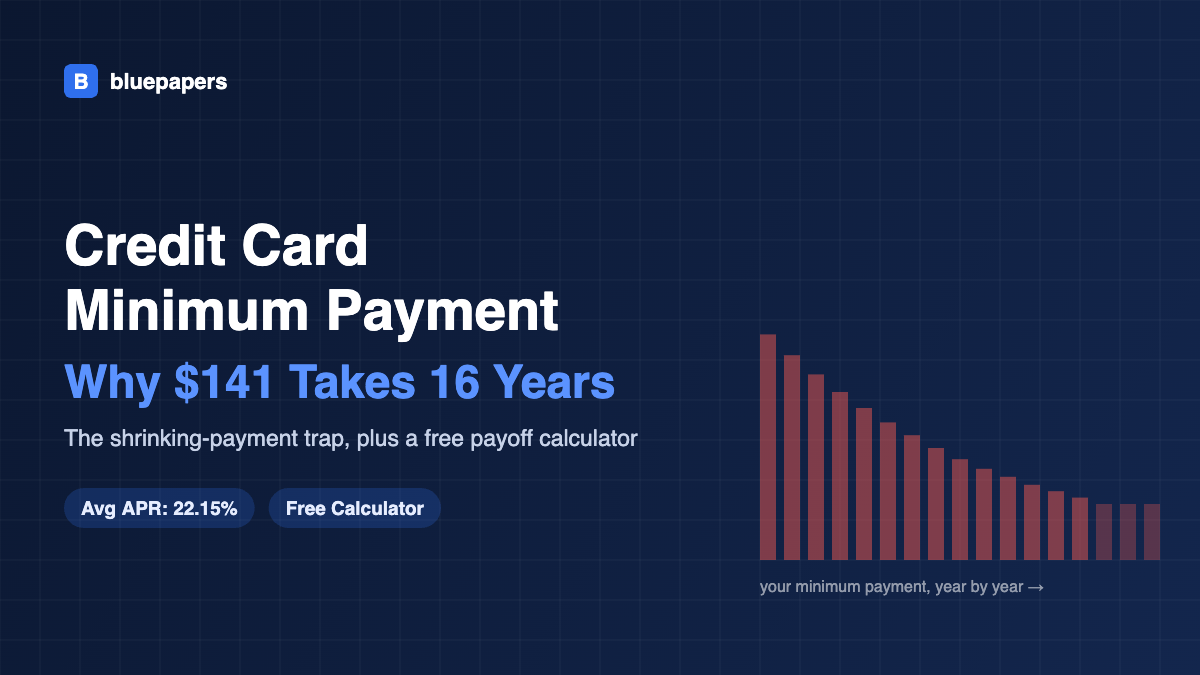
Next month, the balance is $4,950, so the minimum is recalculated on a slightly smaller number. The month after, smaller again. Because your required payment is always a percentage of whatever is left, it never outruns the balance — it follows it down, like a shadow. By year eight, the minimum on this card has fallen to about $55 — and roughly $35 of that is still interest. The final five years are spent grinding away at the $35 floor.
Not every card uses the “1% plus interest” formula. Some store cards and older accounts set the minimum as a flat percentage of the balance instead, and that version is far worse. At 22% APR, a 2% minimum payment covers the interest with only a sliver to spare: the math on a $5,000 balance comes out to more than 80 years and over $43,000 in interest. You’ll find the formula your issuer uses in your cardmember agreement, usually under “Minimum Payment Due.” The calculator lets you switch between the common versions.
What the Minimum Payment Warning on Your Statement Leaves Out
That warning box exists because of the Credit CARD Act of 2009, which requires issuers to show two scenarios on every statement: how long payoff takes and what it costs if you pay only the minimum, and the monthly payment that clears the balance in three years (plus how much you’d save by doing that). The CFPB’s explanation of the three-year box is a good plain-English read on what it does and doesn’t promise.
It’s genuinely useful. But it has three blind spots worth knowing about:
- It assumes you never swipe the card again. Every number in the box is for this month’s balance, frozen in time. Keep using the card and the real timeline is longer than anything printed there.
- It only offers two choices. Minimum, or three years. There’s no middle option — and the middle option (keeping your payment where it is today) is the one most people can actually afford.
- It resets every month. Next month’s box is calculated on a new balance with a new, lower minimum, so the “years to pay off” figure can look like it’s barely moving even while you’re paying on time.
Credit Card Minimum Payment Calculator
Enter your balance and APR from your latest statement — this credit card minimum payment calculator runs the same math as the warning box, plus the option it leaves out. Leave “Your fixed payment” blank to see what happens if you freeze today’s minimum, or type in any amount you could commit to every month.
Assumes no new purchases, no fees, a constant APR, and interest compounded monthly at APR/12. Real statements use daily balances, so your issuer’s numbers may differ by a few dollars. Estimates only, not financial advice. Nothing you enter leaves your browser.
The 30-Second Fix: Freeze Your Payment
If you can't pay the three-year amount right now, don't try to. Do this instead: look at this month's minimum payment, round it up to the nearest $10, and set up an automatic payment for that fixed dollar amount — not "minimum payment due." Almost every issuer's app offers both options side by side, and they look nearly identical on the screen. They are not identical. One follows your balance down for sixteen years; the other stays put and finishes in under five.
Your budget doesn't change, because you're already paying that amount this month. What changes is that every dollar the minimum would have dropped by now goes to principal instead. If you get a raise or pay off something else, bump the fixed amount up once and leave it there. That's all. If you're juggling more than one card, the debt avalanche vs. snowball comparison shows which balance should get the extra money first.
One thing to protect while you do this: never let a payment fall below the actual minimum due. Missing the minimum triggers a late fee, a payment 30 days late can show up on your credit report, and at 60 days most issuers can move your card to a penalty APR, often near 30%. A fixed autopay set at or above today's minimum is safe for as long as you don't add new charges, because the required minimum only goes down from here.
A Three-Year Payoff Rule in Australia
The US leaves the minimum payment entirely up to you. The two other countries I've lived in build in more guardrails. In Australia, credit card statements carry a minimum repayment warning much like the American one. But since January 2019 lenders there also have to check, before approving a card or raising a limit, that you could repay the entire credit limit within three years — a rule set by the regulator ASIC.
The three-year payoff that's merely a suggestion on a US statement is baked into how much credit an Australian bank is allowed to hand you in the first place.
Korea takes a different route. A standard Korean credit card is set up to be paid in full every month — the whole statement balance is simply withdrawn from your bank account on the payment date. Carrying a balance requires signing a separate agreement called 리볼빙 (revolving), and the minimum you then pay each month is set as a share of the bill, commonly starting at 10%.
Financial regulators there have spent the last few years tightening how revolving is explained and advertised, precisely because people were sliding into it without understanding the cost. In Korea, carrying a balance is something you have to opt into. In the US, the minimum is the number printed in the biggest font on the page.
None of that changes the math for an American cardholder — but it's a useful way to think about your own card. Treat the three-year payment as the real price of the balance, and the minimum as the bank's offer to let you stretch it out for a fee you'd never agree to if it were written as a single number.
When Paying the Minimum Is the Right Call
There are real situations where paying only the minimum for a month or two is the smart move: a job loss, a medical bill, a month where rent and a car repair land on the same week. The minimum payment exists so your account stays in good standing when cash is tight — and that matters, because on-time payment history is the single biggest factor in your credit score. Paying the minimum on time is far better than paying more late.
The problem is only when "for now" quietly becomes the plan. If you've paid just the minimum for three months in a row, that's the signal to run your numbers through the calculator, freeze the payment, and check whether an emergency fund — even a small one — would stop the next surprise from landing on the card.
It's also worth checking your debt-to-income ratio if you're planning to apply for a mortgage or car loan soon, since a lender counts your minimum payments in that math. And if your APR is anywhere near the 22% average in the Federal Reserve's latest consumer credit figures, a 0% balance transfer card can buy you 12 to 21 months of interest-free payoff — as long as you pay the fixed amount through the promo period instead of the minimum.
Frequently Asked Questions
How is the minimum payment on a credit card calculated?
Most large US issuers use 1% of your balance plus that month's interest and any fees, with a floor of roughly $25 to $40. Some store cards and older accounts use a flat percentage of the balance instead, often 2% to 3%. Your cardmember agreement spells out the exact formula under "Minimum Payment Due."
How long does it take to pay off $5,000 with minimum payments?
At 22% APR with a 1%-plus-interest minimum and a $35 floor, about 16 years and 5 months, with roughly $7,673 in interest on top of the $5,000. If you instead keep paying the first minimum of $141.67 every month, the same balance is gone in 4 years and 10 months with about $3,121 in interest.
Does paying only the minimum hurt my credit score?
Not directly. Paying at least the minimum on time counts as an on-time payment, which is the most important factor in your score. The indirect damage comes from utilization: a balance that shrinks slowly keeps your credit utilization ratio high for years, and that weighs on your score until the balance comes down.
Is it better to pay a fixed amount or the minimum payment?
A fixed amount, as long as it is at least the current minimum. Because the minimum is recalculated on a shrinking balance, it keeps falling, and each drop stretches your payoff. Setting autopay to a fixed dollar amount equal to today's minimum, rounded up, keeps the payment steady and sends every extra dollar to principal.
Whatever the credit card minimum payment calculator shows for your card, the lesson is the same. The minimum payment is the number your bank chose for you. The fixed payment is the number you choose for yourself. On the same card, with the same balance, that difference is worth more than eleven years.
Related guides
Updated September 29, 2026. Written by Jun, who is not a licensed financial advisor. Example figures assume no new purchases, no fees, and interest calculated monthly at APR/12; your statement uses a daily balance method, so your issuer's figures may differ slightly. Calculator results are estimates for planning purposes only.
Sources: Federal Reserve, G.19 Consumer Credit (September 8, 2026 release) · Consumer Financial Protection Bureau, minimum payment disclosure guidance · Credit CARD Act of 2009 · ASIC, Media Release 18-257MR (three-year period for credit card responsible lending assessments) · Financial Services Commission (Korea), 결제성 리볼빙 서비스 개선방안
Leave a Reply